Posts Tagged ‘abusive situations’

Chronicles in Ordinary Time 102: Bravery

August 26, 2016

whosoever saveth the life of one, it shall be as if he had saved the life of all mankind

Krissy's spice 4 life_smlI would like you to meet Krissy.

She’s one of the bravest persons I’ve ever met. I am not at liberty to tell you her story; it has a lot of bad parts, and the ‘bad’ isn’t over yet. She has countless reasons for giving up; and no desire to do so. She has a spices-and-food-related products business that she has begun to crowdfund. More about that when I know more.

You can find her products at:

https://www.etsy.com/shop/krissyspice4life

https://www.linkedin.com/in/krissyspice4life

and email her at:

krissy.spice.4.life@gmail.com

she can also be twittered at: @krissyspice
We are living in strange times; difficult times filled with pain and betrayal and heartbreak. And yet… and yet… There are stories of heroes.
PBS tells of the Syrian volunteers who rush to bombed buildings to save victims:
Once tailors, bakers, pharmacists, some 3,000 ordinary Syrians are now the unwitting heroes of the Syrian war. Nicknamed “the White Helmets,” members of the Syrian Civil Defense work under the harshest conditions to claw through the remains of buildings flattened by barrel bombs, the Syrian regime’s weapon of choice…
We meet some of them now, thanks to special correspondent Marcia Biggs, who reports from Turkey.

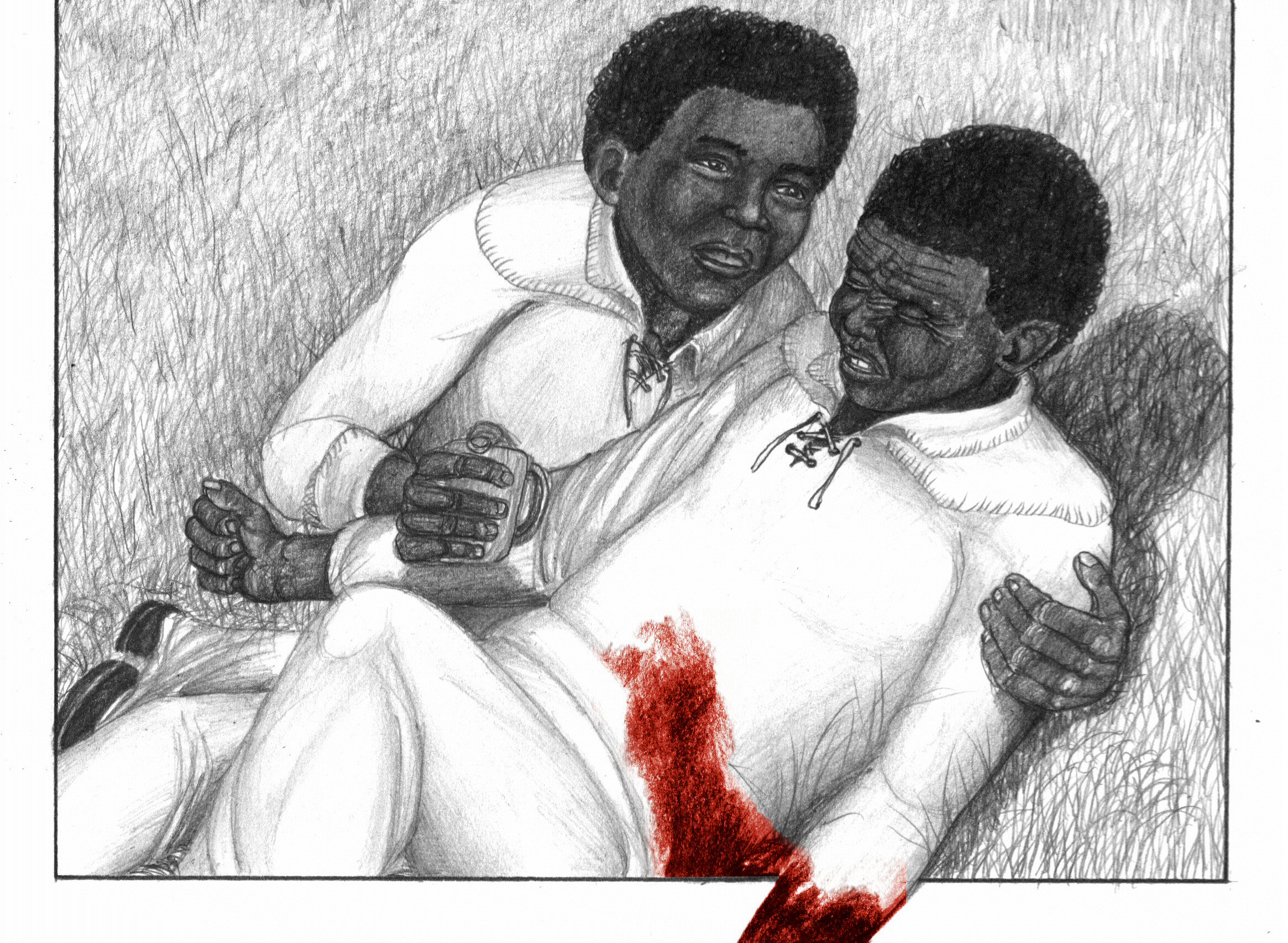
MARCIA BIGGS: We all saw this heartbreaking video, 5-year-old Omran pulled from under the rubble of his flattened home, his photo going viral. Stunned, bloodied, and caked with dust, his face a symbol of so many others.

But the faces you didn’t see in this video are of those who have been pulling people out of the rubble for five long years. This is the call to work for the brave members of the Syrian Civil Defense, an ad hoc grassroots first-response unit within rebel-held Syria.

Over the last five years, they say they have learned, saving almost 60,000 lives, working throughout all parts of one of the most fractured areas on Earth. Even some of the most radical groups allow them into their territory…

MARCIA BIGGS: Abdul Rahman, a 30-year-old volunteer from Aleppo, says the food shortage is a main concern and half of the men in the unit are trying to learn to farm.

Are they worried that they might starve? Are they worried that they’re going to run out of food?

ABDUL RAHMAN, Rescue Worker: Of course, but they’re still working, because we believe in our job. They lost the hope. This is the bigger problem. Now, in Aleppo city, all the world see the besieged. And all the world just watching what happened, and no one do anything.

MARCIA BIGGS: Despite all the deaths and the failures of the international community, the White Helmets soldier on.

RAED AL SALEH (through translator): It’s difficult to talk with our team every day, and most of the time, we have no answers to all the questions they ask. We are doing an important humanitarian job, and we will be rewarded by God.

The Koran says, in the name of God, the most gracious, the most merciful, whosoever saveth the life of one, it shall be as if he had saved the life of all mankind. If you save a human who was under the rubble, it’s like you saved all mankind.

Do you feel proud when you wear that?

For Radi, his uniform a symbol of pride, and for the young man who dreamed of one day getting out of Syria, a renewed pride in his country, which he and the others hope to someday rebuild.

RADI SAAD (through translator): Before the revolution, we didn’t have a sense of belonging to this country at all. But now we feel that, if we don’t build this country, no one will.

MARCIA BIGGS: A small glimmer of hope for the future. For now, every airstrike brings more devastation, and the men, like this one, Fares Mohammed Ali, who dig with their hands and their hearts to raise people out of the ruins and into the light.

One can only wonder how long this light of hope can burn. Fares died last month after an airstrike.

http://www.pbs.org/newshour/bb/syrian-volunteers-rush-bombed-buildings-save-victims/?google_editors_picks=true


I was going to write more words, but at the moments words are failing me.
Fhff7_4


Go back

Your message has been sent

Warning
Warning
Warning
Warning

Warning.


Chronicles in Ordinary Time 11: they didn’t stop to think if they should

February 6, 2012

From the movie, “Jurassic Park”-
“I’ll tell you the problem with the scientific power you’re using here: it didn’t require any discipline to attain it. You read what others had done, and you took the next step. You didn’t earn the knowledge for yourselves, so you don’t take any responsibility for it. You stood on the shoulders of geniuses to accomplish something as fast as you could, and before you even knew what you had, you, you’ve patented it, and packaged it, you’ve slapped it on a plastic lunchbox, and now you’re selling it. Your scientists were so preoccupied with whether they could that they didn’t stop to think if they should. ”

I wonder if the Western World would be as excited to buy a new phone or a new computer device if they realized that a woman was raped in order for the device to be created; or that a child was enslaved; or a parent murdered in order for that electronic gadget to be created?

That’s what’s happening. Our modern electronic devices are made from minerals mined in places like Congo; and the mines are controlled by warlords who enslave their workers. You can view a video by Robin Wright [Princess Bride]:
http://www.youtube.com/watch?v=k4o2lElFzM0&sns=fb

Am I against progress, am I against computers and cell phones? No. I rely on computers to make my life [as I’ve currently defined it] work. I grew up before the personal computer did; I lived most of my life without them.

Do these electronic devices that serve us have to be built by the products of slavery? No.  Economic pressure can be exerted against the slaveholders to change the way they live.

William Wilberforce dedicated his life to the abolition of slavery in Britain. After decades of effort by Wilberforce and countless others, slavery was abolished. In the movie, “Amazing Grace,” the slavery being addressed was in the sugar trade–the life blood of British economy. Even if the wealthy businessmen of Britain were bothered by the abuse of human life [many did not consider Africans as human], they weren’t bothered enough to sacrifice their businesses. I haven’t studied the historical record to know whether the movie is accurate; what is accurate is that determined people can change society.

I hear the word “revolution” brought up more often when I discuss politics with people [something I rarely do]. I immediately think of arming bears [“the right to …”–think about it]; and of all of the unstable people I’ve met, holding AK-47s. A horrible thought.

“Revolution” does not have to come by way of weapons. Thanks to the internet, we live in a time of ‘instant communication’ and ‘social networking.’ Those who are alert have already seen how the ‘viral video’ can change policy. The “Occupy” movement has many detractors, but the movement has demonstrated that public policy can be modified, if those in power fear a danger to their pocketbook. Jesus said that our hearts will be where our treasure is found [Mt. 6:21]. We can change the hearts of tyrants by threatening their treasure.

Chronicles in Ordinary Time 6: Passages

October 13, 2011

I’m not sure that Lydia was into gospel, being a life-long Lutheran.  These lyrics remind me of Lydia:

Your name is written in the book of life
Keep walking in dominion and his might
You serve the Son you serve the One
Who knew you long ‘fore you begun
And you are worthy, and you are worthy
Go ahead, encourage yourself
Look inside and draw from the well
The water flows and heaven knows
That you can’t make it on your own
He said you’re worthy so lets be worthy

So as a man thinketh so does he believe
Faith is not about what you see
It doesn’t matter how you feel
His word is right His love is real
He said you’re worthy, so lets be worthy
Don’t worry; be happy and just say
The light is going to lead me all the way

Lydia was a survivor: she endured the death of her father at an early age; survived being fostered into abusive situations; was a cancer survivor [two mastectomies]; a recover[ed-at last] alcoholic;  had endured twenty or so years living in and raising four children in somewhat primitive conditions in various parts of the world [her husband, Wayne, was a dam engineer]; she endured a number of surgeries, losing some normally-vital parts; and yet, served God in her own way, most of her life. At her funeral, her pastor/friend of 30+ years listed some of  her quiet accomplishments that I’d never heard about, and yet they were not surprising to me–that was what Lydia was about.

I will miss her. I lost my Mom years ago, first to dementia and then in death; Lydia has been my Mom-at-a-distance for a long time. And, I of course, wonder if I ever let her know how important she was to me. Something else to do, when I get Home.
And now she is Home, where there is no more pain, no more suffering.

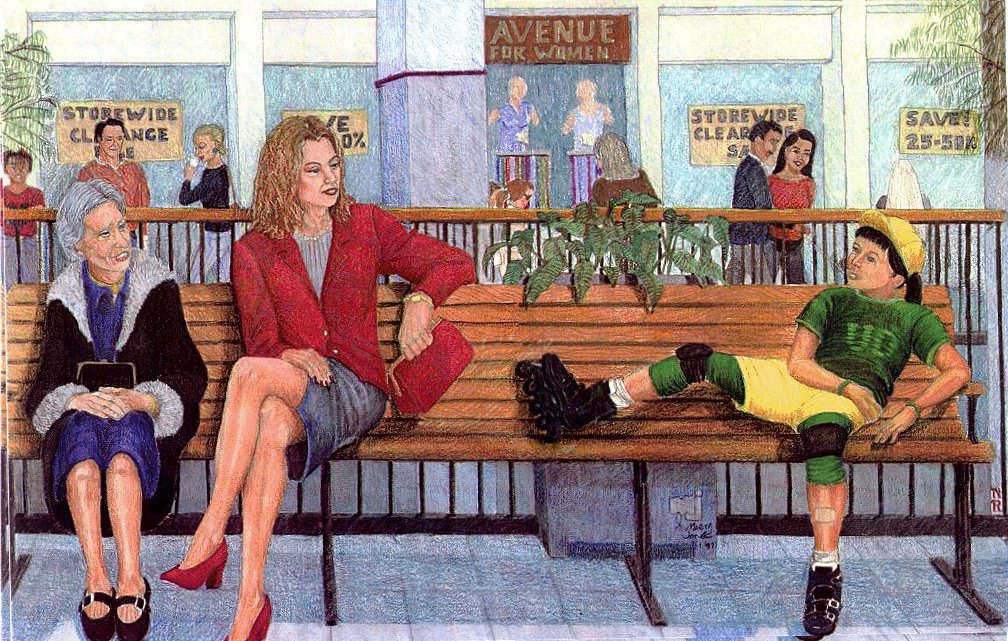
I created this image several years ago; it’s inspired by an obscure Norman Rockwell illustration for a magazine; an image from his vast collection of art.


In a way, the image represents my daughter’s life [symbolically, the one in the middle]. Kat is now 9 years old; I don’t know that she roller-blades. If I were being literal, the one on the left would be my wife, but she’s not there, yet. The woman is closer to Lydia than to Judy; but again, it’s symbolic, today. So, Kat, Jen and GrammaGreat.

Home.
I read “The Shack” during the week we were in Colorado. I’ve avoided the book since I first heard of it–lots of Church people were reading it. I knew the book was controversial, and that should have been my clue to pick it up. I discovered that Wm. Paul Young and I have many of the same ideas. I’m a heretic, in terms of contemporary Evangelical Christianity, so I don’t share a lot about my real understandings of God and my place in the world.

Today’s church world is so anthropomorphic. Taking literally all of the Truth in the Bible, and expecting, to some degree, literal streets of Gold. Believing in a literal bodily resurrection, when most of our bodies are really emptiness.
I believe that our presence with God will be at more of a quantum level; our energy returning to the source of all energy; with, somehow, our personalities intact. We’ll still be us, but without these annoying bodies…
An atom expanded to the size of a football stadium would have a grain of sand in the middle of the 50 yard line; that grain of sand would be the nucleus of the atom. Somewhere orbiting the stadium would be a few more grains of sand, representing the electrons in the atom. The rest would be emptiness. We are composed of millions of atoms, millions of emptiness.

Lydia felt that emptiness at one point, details I won’t get into. And she knew that she needed to turn her life around. AA was a major part of that turning. The emptiness became full; more love for her family, more love for the people in her world, and for the people beyond her world. Love is what fills the emptiness; for God is Love. She didn’t preach, she did get bossy. Her bossiness in my life was an encouragement to become a better person.

God, I will miss Lydia’s presence in my life; I’m glad I’ll see her when I get Home.

forward to:
www.mjarts.com