Posts Tagged ‘artist’

Chronicles in Ordinary Time 70: The Battle of Bedford Falls

April 29, 2015

klara_holdenfrom The Book Lover

   The title of this entry is from a movie reference, Frank Capra’s It’s a Wonderful Life. George Bailey of Bedford Falls opts to take the role of Rescuer instead of the role of Adventurer; and the decision changes the course of his life. He takes on a job he doesn’t want, in order to rescue his family; he marries, ends up living in a drafty old house, takes on the role of father and ends up taking the fall for a mistake supposedly made by a daffy old uncle. On the verge of bankruptcy, he attempts suicide; and is rescued by an unlikely [and non-Biblical] angel. Clarence the angel gives George the gift of seeing what his world of Bedford Falls would have been like had he never been born…

The Battle of Bedford Falls is the battle of making it through another day when everything inside of you wants to opt out of the experience. There are a lot of other options to suicide that accomplish a similar task—‘opting not to play the game’ one more day; and immersing oneself in a variety of activities that postpone the inevitable.

When I started writing for public consumption—this venture into online journaling—I decided that I would only write about things I know about; things in which I have some expertise. I don’t write to gain “followers”—although they are appreciated; and I don’t write to ‘monetize’ my thoughts. I write as a way of exploring my life and myself, and hopefully express in words some thoughts that others may not be able to find the words for. Occasionally using bad grammar…

My only areas of expertise are subjects related to the Building Code; and a very particular style of illustration. These aspects of my life don’t offer a lot of practical wisdom [I wish I’d had more of the former, when I was building the house I’m in]. I’ve built houses, written City policy, raised kids into adulthood and stayed married for nearly 39 years. I’ve rarely left Portland; and at the same time have traveled to the Gulf Coast and to Mexico a few times for construction-related mission work.

I have years of training in how one can change their life for the better, and I’m happier with ‘me’ than I was 30+ years ago; but I only know how to change me—I can’t change other people. The most that I can do is create an environment where people can change, if they desire change. I can offer suggestions [many of which are for me, facts]—but until someone accepts my ideas as their own, they are simply ‘suggestions’. I can provide people with a list of books to study, but I can’t make them read the books or try to implement them into their lives.

There’s rioting in Baltimore; perhaps not tonight, but there has been rioting over the last few days. Rioting in lots of cities, reminding me of the late 60’s—the rioting then had different causes. Throughout the Twentieth Century and overflowing into the Twenty-first, we have become a people who prefer antagonism to mediation. Despite a century of bloodshed, people still pick up weapons in order to feel safe. The proliferation of weapons isn’t making us any safer.

The Battle of Bedford Falls—how do we get through today?

I feel shitty most days, at the start of my day; I start the day, these days, feeling like I did at the end of the day in the past. Due to my neurological issues, my entire body feels wrong; my legs, from the knees down feel wrong, but I’ve been walking for something like 60 years; my muscles know how to walk. I choose to ignore how I feel and walk anyway. The reality is that I know of dozens of people who are in worse shape than I am. So I start my day in prayer, listening to music that turns my mind toward the Creator and my inner self. I ‘lift people up’ in my prayers—I’m not smart enough to tell the Creator what His creation needs. Praying for others takes my mind off of myself. Do my prayers change the world? I have no idea. They change me, over time. Among those changes are a growing list of people—I pray for people I don’t know, I pray for people I’d rather not talk with.

I make sense out of my life by the belief that this life is but an eyeblink in the span of Eternity. I was told long ago, that we are minds with a body, rather than the reverse. Over time I have come to believe that we are Eternal souls that have a mind and a body. That Earth is a place where we are intended to learn how to live well with our fellow creatures. I believe there is another ‘plane of existence’ that isn’t tied to bodies and disease and suffering; and that we arrive at that plane when we leave these damaged bodies behind. I also believe that we could do a much better job of living with each other than we do. It’s our greed, our stupidity, our selfishness that makes this world a garbage heap…We blame God for not stopping us from doing the things we can do by our own choice.

And this is a lousy way to end this entry…probably indicative of my mood—I’ve been repairing a washing machine over the last couple of days, and I dislike the toll it’s taken on my body and mind. It used to be a lot easier.

In spite of a lot of evidence to the contrary, I look forward to seeing what another few years will bring into my life. I’ve met people I would not have met before; there are people I care about now that I didn’t know a couple of years ago. Granted, I’m not seeing a lot of points on the ‘win’ side of the ledger these days, but I lack the ability to see into the future. I have to wait for the future to show up. I see my kids overcoming huge obstacles, and I believe they will continue to move forward. Every day I see indicators of positive change for the future of mankind—if we will stop fighting each other long enough to pay attention. We walk in the shadows of giants; and I believe we will see more giants in the future, if we will simply pay attention.

Go back

Your message has been sent

Warning
Warning
Warning
Warning

Warning.

Chronicles in Ordinary Time 23: Sustainability

November 20, 2012

Go back

Your message has been sent

Warning
Warning
Warning
Warning

Warning.

I just finished watching Ken Burns’ “The Dust Bowl;” chronicling the 30 or so years that it took to turn a self-sustaining savannah of Buffalo Grass into what almost became the Sahara Desert revisited. Land that should never have been cultivated, because it can’t sustain agriculture. Rain is infrequent, but Buffalo Grass had roots that grew 5ft into the ground. The ‘Dust Bowl’ happened because wheat ranchers over-cultivated land that should have been left for grazing. I didn’t keep track of the numbers; but the narration speaks of millions of tons of topsoil that was blown away. At one point in the mid-30’s, Oklahoma dust fell on a tanker 300 miles at sea.

The area where the Dust Bowl once existed is now used for “corn” production, which requires even more water than wheat. The water for this production is pumped out of the Ogallala Aquifer. Not only does the aquifer provide water for irrigation, but it also provides drinking water for much of the central plains.  Some estimates say the aquifer will dry up in as few as 25 years. The Dust Bowl will very likely return. Drinking water used for hog feed.

Why are we so stupid?

The farmers came because they wanted to own land, and to make a life for themselves and their descendants. A valid desire. The Ken Burns story references the writings of Carolyn Henderson; a woman who came to Oklahoma looking to build a life for herself and her husband, and their family. I have relatives who are Hendersons, probably not related; my father expected to be a wheat rancher, here in Oregon. The Ken Burns story pushed ‘buttons’ that I prefer keeping un-pushed.

In America we have the freedom to ruin the land that sustains us. We do things because we can; not because we should. This too, is the American Way.

There are those who had the ability to create a ‘dust bowl’ of our economy. Not just the American economy; but much of the Western world’s economy.  The homeless [both on the street, and those who now live with family and friends, having lost their homes] are the ‘Okies’ of today. Victims of our own foolishness and/or lack of foresight. We over-cultivated our economy, in the same manner as did those who created the Dust Bowl. The parallels are frightening.

I am heartened by individuals in my children’s generation; people who want to repair the land, and live in a more sustainable manner. It requires a divorce from consumerism; which drives our economy. So, we not only need to live a more sustainable lifestyle when it comes to agriculture and energy production; but we also need to wean our economy off of consumerism, and into sustainability.

A large portion of the population of our world live in tin shacks or mud huts. They have internet access in this world of dire poverty; the contrast is also staggering.

Black Friday is coming, this week; and retailers are excited. During the time of the Dust Bowl, there occurred a Black Sunday. Walls of dust, thousands of feet tall, blocked out the light of the sun for hours on end, for much of the Plains states. I wonder if our upcoming Black Friday is also leading to a Black Sunday in the future.

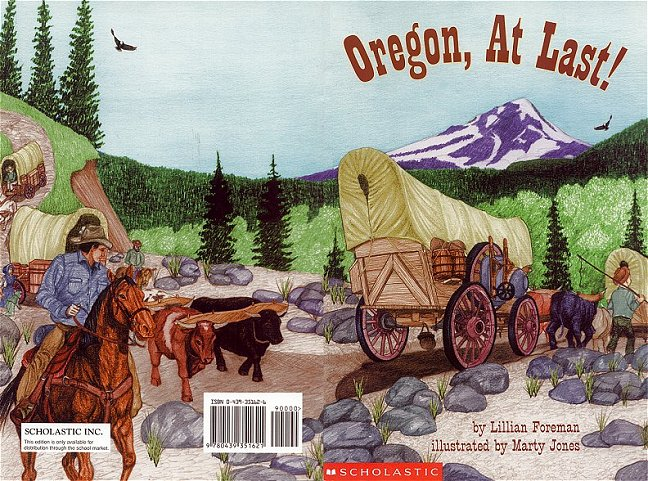
Cover art for Scholastic’s “Oregon At Last”

Chronicles in Ordinary Time 22: Recent Images

November 9, 2012


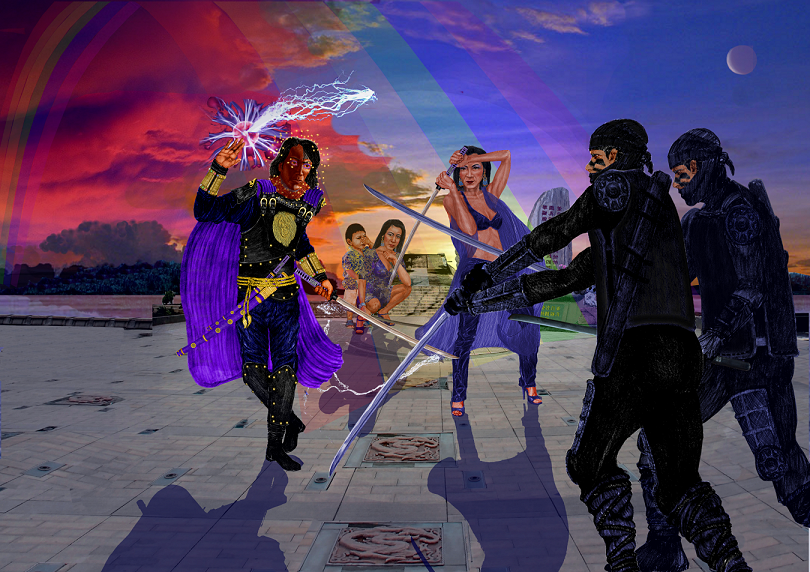
Photoshop Humor

Images inspired by the Grand Staircase in the movie, ‘Titanic’

cropped version:


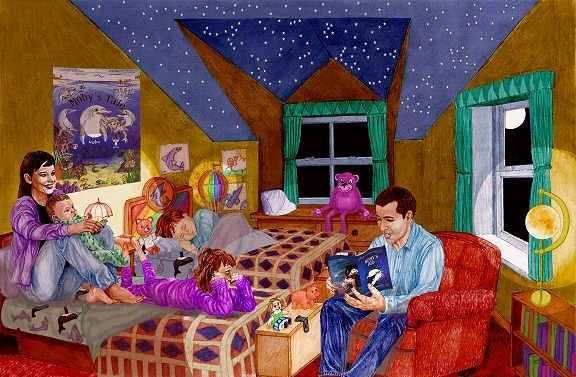
Illustration from a ‘work in progress’ children’s book:


Chronicles in Ordinary Time 13: the predicament of nuclear man

February 27, 2012

Today is my 39th Re-Birthday.

The first part of Henri Nouwen’s “The Wounded Healer” [The Search of Nuclear Man] describes my theological quest for meaning in life: “When we look around us we see man paralyzed by dislocation and fragmentation, caught in the prison of his own mortality. However, we also see exhilarating experiments of living by which he tries to free himself of the chains of his own predicament, transcend his mortal condition, reach beyond himself, and experience the source of a new creativity.”
Using Nouwen’s categories, I was a Mystic in a time of theRevolutionaries during the first half ‘the seventies’. Too bound by my upbringing to truly become a Revolutionary–I considered emigrating to Canada to avoid the Draft, but didn’t have the nerve. I was ‘saved’ by a very high draft number. Had I been born 4-6 hours earlier in my 10-month gestation, I would have probably become a 2nd Lieutenant in Vietnam, with a 20-minute life expectancy. I had no religious beliefs nor upbringing, so I could not become a conscientious objector; even though that was an appropriate definition.

I came to life in college.
I really have very few memories from childhood. Memories from our family cabin on the Sandy River, near Brightwood, Oregon. Some hormonal experiences/dreams. Some boring trips to my grandmother’s house in Condon, Oregon. Memories of my Grandparents’ house. Helping my ‘Grandfather’ [great uncle] build their last house. Riding my bicycle/jumping off of my bicycle onto our lawn. Playing in the back yard of my across-the-street neighbor/best friend, Bobby. There are more memories from high school, although not a lot. Memories of my best friend, Pete; and my other best friend, Mark. Pete remains on the periphery of my life; Bobby and Mark are absent.
For many years, I felt as though I could clearly remember every day of my two years at Oregon State. Discovery. The beginnings of an understanding of who I am. Chronic despondency. Hours and hours in my darkened room, listening to the dreary music of Rod McKuen and other folksingers who saw the problems of life, but had few suggestions for improving the situation.
“In the absence of clear boundaries between himself and his milieu, between fantasy and reality, between what to do and what to avoid, it seems that [he] has become a prisoner of the now, caught in the present without meaningful connections with his past or future. When he goes home he feels that he enters a world which has become alien to him. The words his parents use, their questions and concerns, their aspirations and worries, seem to belong to another world, with another language and another mood. When he looks into his future everything becomes one big blur, an impenetrable cloud. He finds no answers to questions about why he lives and where he is heading. [He] is not working hard to reach a goal, he does not look forward to the fulfillment of a great desire, nor does he expect that something great or important is going to happen. He looks into empty space and is sure of only one thing: If there is anything worthwhile in life it must be here and now.”

At University of Oregon I encountered The Eternal. I lived across the hall from two of those ‘annoying Christians,’ who in time, became close friends; Brad remains my spiritual ‘father/big brother’. After months of asking, I finally agreed to go with them to their Sunday night meal and Bible study at the pastor’s house. One gathering sticks in my mind; the group was kneeling in a circle at the end of the evening, praying; and I realized that these people were not delusional, they actually were in contact with someone I did not know, nor had ever heard about.
“For the mystic as well as for the revolutionary, life means breaking through the veil covering our human existence and following the vision that has become manifest to us. Whatever we call this vision-“The Holy,” “The Numinon,” “The Spirit,” or “Father”-we still believe that conversion and revolution alike derive their power from a source beyond the limitations of our own createdness.”

While I consider today to be the anniversary of my rebirth, it really didn’t happen on an individual day. It probably started in my second year at Oregon State, when I told my good friend, Jeff, to quit bugging me about his newly-found belief in Jesus: the story of the druggie that had an overnight conversion and became a street preacher. Our 2am sessions in the dorm hallway, Jeff singing Crosby, Stills and Nash in a voice like Neil Young; and then singing strange Christian songs in the same voice. He moved his ministry to University of Oregon after I wrote  a lonely letter describing my living among strangers. The conversion process continued actively for my next three years at U of O and my first couple years after college. By the time I was 28 I was indelibly altered.

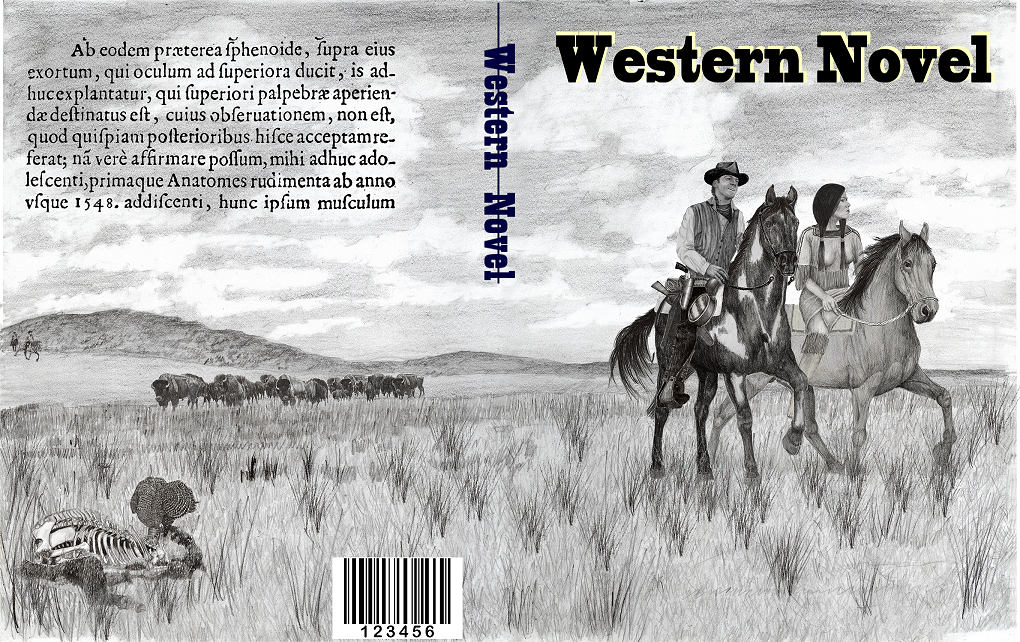
After nearly 50 years of an artist’s life, I really can’t find a single image that represents my coming to faith. Which is probably why I consider myself an illustrator rather than an artist. I don’t do well with creating abstract images; and the conversion to faith is an abstract process. The Apostle Paul’s description of life as a battle may have something to do with my fascination with Asian martial arts movies, even though I’m a pacifist. One of the reasons I could not honestly become a member of the Society of Friends [Quakers]; even though their beliefs are probably more along the lines of my own than the conventional Protestant church.

“…and the monstrous creatures of whales” [below] probably represents my faith most adequately, although I really don’t know why.  The Eternal cannot be described in an image; the wonder of Creation can perhaps best be described by the ocean of the South Pacific [I’m not familiar with the South Atlantic]. Warm, teaming with life, teaming with Wonder. I invested two years of my life creating the full-size image from which the image below is derived; in the *interesting* nature of my life, I can’t justify the expense of printing the image in its glory…

Chronicles in Ordinary Time 10: Advent

December 16, 2011

[“Adoration of the Magi” acrylic, inspired by a Norman Rockwell painting: http://www.mjarts.com/port_1a.htm ] Chris Tomlin: Amazing Grace (My Chains Are Gone)

Did you know that Jesus wasn’t a Christian?
He was a Jew. All of His followers were either Jews or were seeking something More for their lives. These believers were later called “Christians,” but they referred to themselves as “followers of the Way.”
He probably wasn’t born in the Winter.
The “Wise Men from the East” didn’t arrive at the stable and the manger. Jesus was probably around 2 years old, when the Wise Men arrived. After the Wise Men left Herod the King, having told him about the birth of the promised Messiah/King, Herod ordered the deaths of all of the male babies 2 years old and younger.
But it makes for a good story.
For today’s times, I prefer this Advent Allegory by Jonathan Gray:
http://www.youtube.com/watch?v=XOlVheWcfhA

The Emperor Constantine legalized/”officialized” Christianity in the 4th Century. The Church has been messed up, ever since, confusing the Way of Faith with the ways of commerce and politics.

When the Holy Roman Empire moved into northern Europe, the priests re-purposed  the ‘pagan’ religious winter festivals into Christian feast days, so that Christianity would be more palatable to the folk they found there. This is human nature. Parents do it with their children all the time.

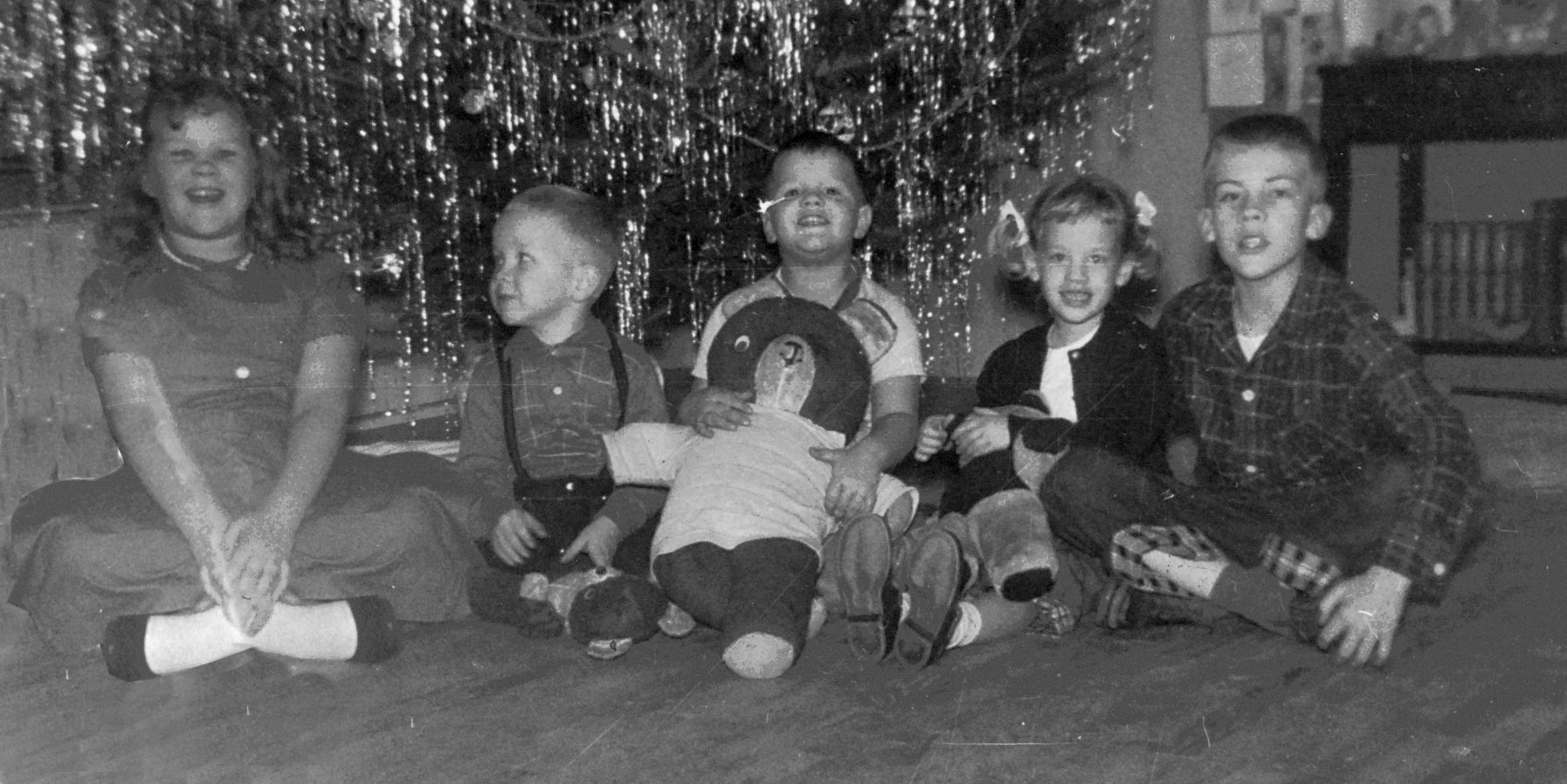
My Christmases, when I was a child:

This was taken in the mid-1950′s. I’m the kid looking at my cousin, Carol [Sunny]. Not sure why I wasn’t looking at the camera. Sort of symbolic, in a way, I’ve always looked in directions the rest of the world doesn’t. I still have the bear on the floor in front of me. These days, with my messed-up peripheral sensory nerves, I miss flannel-lined jeans [my cousin Jim, on the right, is wearing a pair]. My cousins, Bruce and Wendy are between Jim and I.

My first Advent was in 1973. That’s the year that I learned that the Eternal and Infinite Master of the Universe had, at a point in history, entered Time and Space. Seemingly impossible, unless one is Omnipotent. In 1973 I realized that this event was sort of  similar to my lifting up a rock, and deciding to become one of those crawly things scurrying around, under the rock. Only on a Much Larger Scale…
For 30 or so years, the incarnate Eternal apparently didn’t do much that one might expect from the Creator of the Universe. Jesus did the same sort of stuff that we do. Our Creator knows what it feels like to be human. Our Creator knows our struggles. At the same time, our Creator knows that our time here on earth is like an eyeblink in the span of Eternity–the existence for which we are created.
For three or so years, Jesus did the sort of things that the Creator of the Universe might be expected to do, and as a result, the religious leaders of the day arranged for His crucifixion. They wanted Him gone; only He came back, and told His followers that death wasn’t The End, it was simply The New Beginning…

I try to live with the message of the incarnation in my life, every day, as much as I can. It’s a little harder at this time of year. So many people are madly involved in celebrating Something Else. When our children were small, we got more involved in “Christmas”–there is something magical about the expression on a child’s face, their belief in the ‘magic’ of the lights, the presents, the wonder of the whole thing. A shadow of what the shepherds might have felt when they were in the presence of angels.

I told our children about Saint Nicholas, the real bishop, whose story somehow got transformed into Santa Claus. One year, to my complete incomprehension, there really were parallel lines on our driveway, and little round spots mingled among the lines…I still can’t come up with a more plausible explanation than the impossible presence of a sleigh and reindeer.

Advent. The time that marks the coming of our Creator into the world, with a message of forgiveness. We don’t have to continually beat up on ourselves, or beat up on other people in order to make our lives work better. We are accepted, the way we are; all we need to do is live in that state of acceptance. We can also become better than we are, because our Creator’s Grace can live inside us. Not so that we can experience magic, but to create wonder.

And, like Malchus, in the Garden of Gethsemane, we can be healed.

A blessed winter time of celebration, to you all.

Peace, and good will toward you all. May the coming year be filled with Hope.

Marty


Chronicles in Ordinary Time 9: Occupying Our Hearts

November 13, 2011

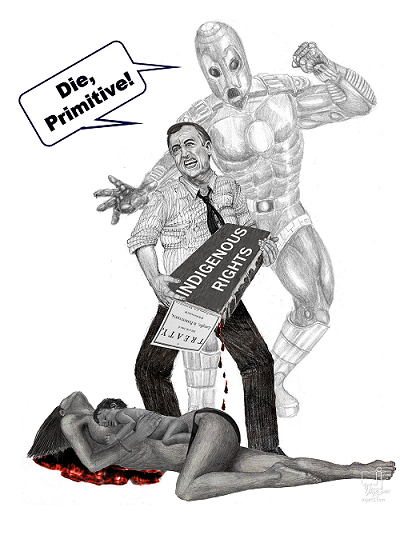
This illustration was created for Ken Gunther, for an upcoming book to be published by Gaiadigm Books.

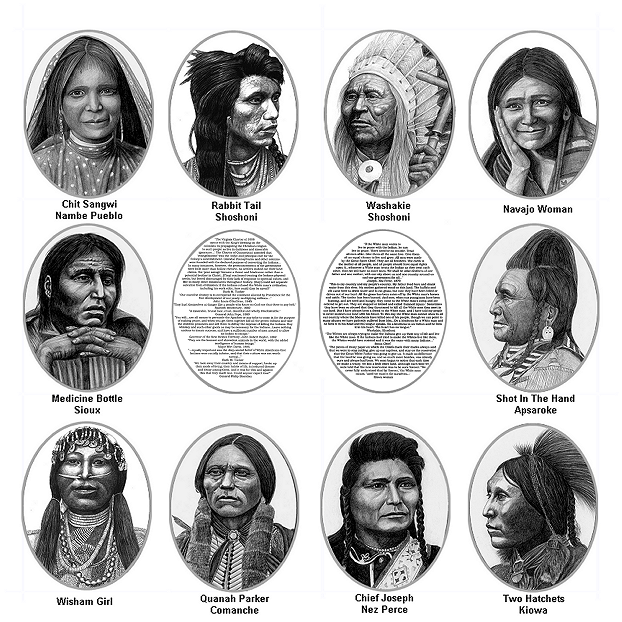
Somewhere in the eighties I started drawing Native American portraits, some of which were compiled in the image below [John_10-16]. The process of searching for new images became a study of our government’s treatment of the indigenous peoples who lived here before the Europeans came; and the slaughter of those Nations.

Nations. Our government recognized these peoples as Sovereign Nations, and prepared Treaties with these Nations; and then systematically broke all of the Treaties.

In the image below, the words in the oval on the left state that the purpose of most of the early colonies was evangelism; over time the presence of the Native Americans became an obstacle…

“Our manifest destiny is to overspread the continent allotted by Providence for the free development of our yearly multiplying masses.”
John Louis Sullivan, 1845

“In treachery, broken pledges upon the part of high officials, lies, thievery, slaughter of defenseless women and children, and every crime in the catalogue of man’s inhumanity to man, the Indian was a mere amateur compared to “the noble white man.” His crimes were retail, ours wholesale.”
Lt. Britton Davis, 1884

In the image below, the oval on the right offers quotations from half a dozen “Indians” who spoke words that should have come out of the mouths of Christians of that time. Words that echo what Jesus taught.

The Lakota used a metaphor to describe the Europeans who arrived on their lands.
“It was Wasi’chu, which means “takes the fat,” or “greedy person.” Within the modern Indian movement, Wasi’chu has come to mean those corporations and individuals, with their governmental accomplices, which continue to covet Indian lives, land, and resources for private profit.
Wasi’chu does not describe a race; it describes a state of mind.
Wasi’chu is also a human condition based on inhumanity, racism, and exploitation. It is a sickness, a seemingly incurable and contagious disease which begot the ever advancing society of the West. If we do not control it, this disease will surely be the basis for what may be the last of the continuing wars against the Native American people.”
…excerpt from Wasi’chu, The Continuing Indian Wars,
Bruce Johansen and Robert Maestas
with an introduction by John Redhouse
[ http://www.dickshovel.com ]

Evangelical Christians in the US seem to have a short memory. We talk about being a nation ‘blessed by God’ and overlook the slaughter of the Nations that were here at the beginning. We overlook Hiroshima and Nagasaki as crimes against humanity. And somehow we call our nation “blessed”. How can we justify these actions of the past as Christian actions?

The “Occupy…” movements of today, I believe, are a reflection of the some people’s recognition of the spirit of Wasi’chu among us. We live in a country of vast inequalities. I do not believe the answer is simply “redistribution of wealth”. When the wealthy refuse to be taxed at the same rate as the non-wealthy, at the expense of “social services,” I think we have a problem of Wasi’chu.

What Would Jesus Do?
I don’t know; the Gospels do not include any instances of “Occupy Jerusalem”. Jesus lived under the foot of an Emperor; and such movements would have probably ended with death and maiming.

In an interview with Gary W. Moon written in “Conversations
Journal” [ http://www.philipyancey.com/wp-content/uploads/2011/11/WhatGoodIsGod-Yancey-and-Moon.pdf ], Philip Yancey writes:
For one thing, Jesus didn’t live in a democracy; he lived under an occupying power, the most powerful empire of its time. In such circumstances, you can either accommodate the ruling power, as the Sadducees did, or violently oppose it, as did the Zealots. Jesus mostly ignored it. He said nothing about the brutality of the Romans or some of their nefarious practices, such as gladiator games, pederasty, and the abandonment of infants. His guiding principle, “[Give] unto Caesar the things that are Caesar’s, and unto God the things that are God’s,” is wonderfully ambiguous (Luke 20:25, ASV).

GWM: So, if you could write a one or two-sentence prescription for the
church in the US and you were sure it would be followed, what would you prescribe?
PY: Spend less time and energy trying to clean up the culture around you—a task Jesus and Paul did not seem concerned about—and more time and energy creating a counter-culture that presents a compelling alternative while exposing the shallowness of its surroundings.

I don’t think I can say it any better.

Chronicles in Ordinary Time 7: Vision

October 22, 2011

    I am fascinated by perception. What I see is not what you see. What you see is probably similar to what I see; but not exactly the same. On top of that, what we see isn’t really seeing, at all.

     Light reflects off of the candle; the image is reversed by the lens of our eye; and the light hits the rods and cones–light receptors–of our retina. The electrical impulses caused by the the light image reacting on the rods and cones, travel to our brain via the optic nerve. Our brain then translates the electrical impulses into a ‘virtual image’ that ‘appears’ in our brain. That ‘image’ seems to be similar to what we see on a TV or LCD screen; however we don’t have a screen in our brain.

    A particular shade of red may not be the same to me as it is to you. People with red/green color blindness have that which “…is the inability or decreased ability to see color, or perceive color differences, under lighting conditions when color vision is not normally impaired. “Color blind” is a term of art; there is no actual blindness but there is a fault in the development of either or both sets of retinal cones that perceive color in light and transmit that information to the optic nerve.”[wikipedia]

    People with Irlen’s Syndrome can only see the ordinary printed page properly through colored light or when colored paper is used. Black letters on a white page send scrambled signals to the brain. With my astigmatism, I can’t see lines clearly unless the lenses of my eyes are corrected by glass lenses worn over my eyes.

    Animals seen in an entirely different manner, both structurally–in the nature of their eye construction; and in the wavelengths of light that they see. Many animals see in the ultraviolet and infrared ranges of the color spectrum. [see list] They see things we cannot see without the use of technology–night vision goggles, etc.

     To take this a step further– our brains, our eyes are composed of millions of atoms. If one were to enlarge an atom to the size of a football stadium, the nucleus of the atom would be the size of a grain of sand. The electrons orbiting around the stadium would also be the size of a grain of sand. All the rest of the atom would be empty space filled with electromagnetic energy.

    Our brains, like the rest of our body, are really composed mostly of empty space [yes, those people actually were correct]. That which we know about our bodies is mostly comprised of electromagnetic energy found in the visible range of the spectrum. The visible portion of the electromagnetic spectrum is only a small portion of the entire range, which extends from low frequencies used for modern radio communication to gamma radiation at the short-wavelength (high-frequency) end, thereby covering wavelengths from thousands of kilometres down to a fraction of the size of an atom. In principle the spectrum is infinite and continuous. In principle, we are infinite and continuous.

     Isn’t this what faith leads us to?

forward to:
www.mjarts.com

Storytelling…

September 5, 2011

To me, this is the heart of illustration– to tell a story; to make a story more clear and understandable by the use of images.

My fear, and my frustration, is always that I haven’t served the story well enough with my illustrations. This sometimes happens when I have to rush to meet a very short deadline.

Jesus told parables- stories- so that those who chose to listen to his stories would ask, “…why is He saying that? what does it mean?”

The ultimate answer to all of our questions is I AM– the story the Eternal told Moses. “You shall know this day and place it in your heart that the Eternal is God in heaven above and on earth below; ain od.” [Deuteronomy 4:39]

“ain od- a Hebrew expression in this verse meaning there is nothing else.” [Dr. Gerald Schroeder, The Hidden Face of God]

I believe that one of our purposes here on earth is to share our stories with others; to build stories with others; to pass on our stories to those that follow us.

Blessings, Marty