Posts Tagged ‘Christianity’

Chronicles in Ordinary Time 12: to tame the savageness of man

February 6, 2012

A friend of mine posted an article on Facebook, an analysis of the Republican Party and it’s apparent trend toward Social Darwinism. Along with the article was my friend’s comment: “who do we really turn to to resolve these issues?”

My reply: “God help us, I’m not sure they are in politics, yet. Maybe they’ll arrive sometime in the future. To me, at this point in time, it seems like, ‘endure, and survive’.”

I watched the movie “Bobby” this evening, written and directed by Emilio Estevez. Emilio  shook Bobby’s hand at the age of 5, and it forever changed Emilio’s life.

I’d forgotten…

There was a time; there was a champion, beloved and respected by many. He was bringing people of all colors and creeds together; with hope for a new beginning.
His father called him the ‘runt’ of the Kennedy clan. US Attorney General under his brother’s Presidency, he was known by most people, and he was disliked by many in ‘the Establishment’. The Senator from New York was not expected to follow in his brother’s footsteps; but he felt a call to speak for a new time…

“If we believe that we, as Americans, are bound together by a common concern for each other, then an urgent national priority is upon us. We must begin to end the disgrace of this other America. And this is one of the great tasks of leadership for us, as individuals and citizens this year. But even if we act to erase material poverty, there is another greater task, it is to confront the poverty of satisfaction—purpose and dignity—that afflicts us all. Too much and for too long, we seemed to have surrendered personal excellence and community values in the mere accumulation of material things.** ”

I was 15 when Bobby was assassinated. I was fairly oblivious. A classmate in high school was devastated. I don’t remember his name, but he was an outspoken Protestant Irishman. I didn’t understand, nor did I care to understand his political beliefs; but his passion I have never forgotten.
Over the years, I have grown to understand Bobby’s significance in American history, and the loss we suffered. By the time I turned 18, three short years later, and was facing the Draft and probable end of my life in Vietnam, I was no longer oblivious.

I find, at this period of my life, I get angry during election years. I get angry at the political rhetoric; I get angry at the posturing; I get angry when I hear comments that seem to have no understanding of what I believe we are supposed to be as people.  I lean toward the Progressive Liberal side of the spectrum; mostly because of my understanding of the teachings of Jesus. The oddity of me calling myself a Progressive Liberal is that I’ve been a Republican for most of my life; a follower of Theodore Roosevelt and Abraham Lincoln–ardent Progressive Republicans. I’m currently a part of a church whose membership is largely made up of people from the other end of the political spectrum than I, who tend to be of the party affiliation that I’ve fled.
I dislike getting angry with comments from the people I attend church services with. I prefer the company of books and movies to the company of people; it’s an effort for me to be among people on a weekly basis. However, I know that my soul needs to associate with fellow Believers. As my life has become so closely involved with Bobby’s quotation from Aeschylus, I don’t know that I have gained that much wisdom from living a life filled with pain…and now a life where the ability to feel pain is continuing to diminish. I know, from my living among other Believers, that the Eternal inhabits prayer. The Eternal does not necessarily provide answers to prayer; but those who pray can become more.

I had hoped that the miraculous event that occurred in 2008 would perhaps usher in a New Time in America. It seems to have mostly intensified the America of my young adulthood. That “other America” Bobby spoke of. My children are all in the vicinity of their thirties–one side or the other– and I wonder if they will see the Arthurian vision of Camelot in their lifetimes…

The fictionalized character of busboy Juan Romero, who was holding Bobby’s hand when the Senator was shot in the Ambassador Hotel.

and thus ended the vision of Camelot for my generation.

**http://www.jfklibrary.org/Research/Ready-Reference/RFK-Speeches/Remarks-of-Robert-F-Kennedy-at-the-University-of-Kansas-March-18-1968.aspx

Chronicles in Ordinary Time 9: Occupying Our Hearts

November 13, 2011

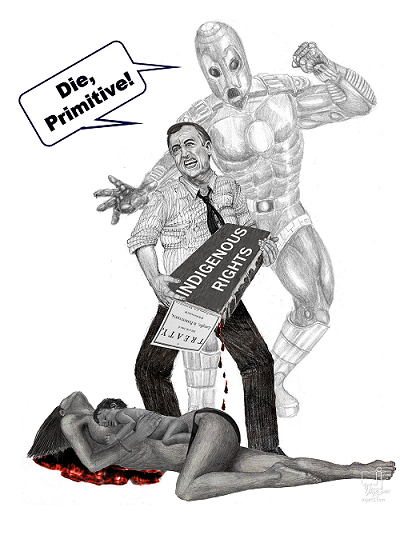
This illustration was created for Ken Gunther, for an upcoming book to be published by Gaiadigm Books.

Somewhere in the eighties I started drawing Native American portraits, some of which were compiled in the image below [John_10-16]. The process of searching for new images became a study of our government’s treatment of the indigenous peoples who lived here before the Europeans came; and the slaughter of those Nations.

Nations. Our government recognized these peoples as Sovereign Nations, and prepared Treaties with these Nations; and then systematically broke all of the Treaties.

In the image below, the words in the oval on the left state that the purpose of most of the early colonies was evangelism; over time the presence of the Native Americans became an obstacle…

“Our manifest destiny is to overspread the continent allotted by Providence for the free development of our yearly multiplying masses.”
John Louis Sullivan, 1845

“In treachery, broken pledges upon the part of high officials, lies, thievery, slaughter of defenseless women and children, and every crime in the catalogue of man’s inhumanity to man, the Indian was a mere amateur compared to “the noble white man.” His crimes were retail, ours wholesale.”
Lt. Britton Davis, 1884

In the image below, the oval on the right offers quotations from half a dozen “Indians” who spoke words that should have come out of the mouths of Christians of that time. Words that echo what Jesus taught.

The Lakota used a metaphor to describe the Europeans who arrived on their lands.
“It was Wasi’chu, which means “takes the fat,” or “greedy person.” Within the modern Indian movement, Wasi’chu has come to mean those corporations and individuals, with their governmental accomplices, which continue to covet Indian lives, land, and resources for private profit.
Wasi’chu does not describe a race; it describes a state of mind.
Wasi’chu is also a human condition based on inhumanity, racism, and exploitation. It is a sickness, a seemingly incurable and contagious disease which begot the ever advancing society of the West. If we do not control it, this disease will surely be the basis for what may be the last of the continuing wars against the Native American people.”
…excerpt from Wasi’chu, The Continuing Indian Wars,
Bruce Johansen and Robert Maestas
with an introduction by John Redhouse
[ http://www.dickshovel.com ]

Evangelical Christians in the US seem to have a short memory. We talk about being a nation ‘blessed by God’ and overlook the slaughter of the Nations that were here at the beginning. We overlook Hiroshima and Nagasaki as crimes against humanity. And somehow we call our nation “blessed”. How can we justify these actions of the past as Christian actions?

The “Occupy…” movements of today, I believe, are a reflection of the some people’s recognition of the spirit of Wasi’chu among us. We live in a country of vast inequalities. I do not believe the answer is simply “redistribution of wealth”. When the wealthy refuse to be taxed at the same rate as the non-wealthy, at the expense of “social services,” I think we have a problem of Wasi’chu.

What Would Jesus Do?
I don’t know; the Gospels do not include any instances of “Occupy Jerusalem”. Jesus lived under the foot of an Emperor; and such movements would have probably ended with death and maiming.

In an interview with Gary W. Moon written in “Conversations
Journal” [ http://www.philipyancey.com/wp-content/uploads/2011/11/WhatGoodIsGod-Yancey-and-Moon.pdf ], Philip Yancey writes:
For one thing, Jesus didn’t live in a democracy; he lived under an occupying power, the most powerful empire of its time. In such circumstances, you can either accommodate the ruling power, as the Sadducees did, or violently oppose it, as did the Zealots. Jesus mostly ignored it. He said nothing about the brutality of the Romans or some of their nefarious practices, such as gladiator games, pederasty, and the abandonment of infants. His guiding principle, “[Give] unto Caesar the things that are Caesar’s, and unto God the things that are God’s,” is wonderfully ambiguous (Luke 20:25, ASV).

GWM: So, if you could write a one or two-sentence prescription for the
church in the US and you were sure it would be followed, what would you prescribe?
PY: Spend less time and energy trying to clean up the culture around you—a task Jesus and Paul did not seem concerned about—and more time and energy creating a counter-culture that presents a compelling alternative while exposing the shallowness of its surroundings.

I don’t think I can say it any better.