I write these posts as a way of processing the world as I see it—the view from an introverted, INTJ, ‘stranger in a strange land’ perspective. There is much in human behavior that I have never comprehended.
Sometimes I write because I want to cause you who are reading this to examine your world.
Those of you who’ve read these posts in the past are aware that Faith is the most important component of my life. Being an asocial personality who prefers the life of a recluse to having a social life; if I’m honest, I only care about the people that I know, the people who have some impact on my life. I comprehend that as a person of Faith, my scope of caring is supposed to be wider; I’ve been working on this concept for 40 years. I still have a distance to go.
I wasn’t raised with faith; I was raised without a presence of God in my life. During my third year of college I discovered Faith, I was led to Faith. I assumed that my parents had never heard the Good News of Jesus; I soon learned that they didn’t want to hear anything I had to say; they’d heard it before… Evangelism has never been one of my strengths; on the other hand I really can’t comprehend how people who have seen what I’ve seen and heard what I’ve heard can’t understand what I understand. Maybe they haven’t seen and heard…I so often wish I could download Faith into someone’s brain as easily as one downloads an app…
Courtesy of Facebook, I recently read an article that implied that the contemporary Church’s acceptance of people with ‘alternative lifestyles’ is the cause of much of the chaos present in the world today; and presented a photo that implied that tattooed, pierced people were symptomatic of the problem. Probably an implication of one of my favorite saints, Pastrix Nadia of House for All in Denver, Colorado… To be honest, I couldn’t get through the entire online article; apologies if I misunderstood.
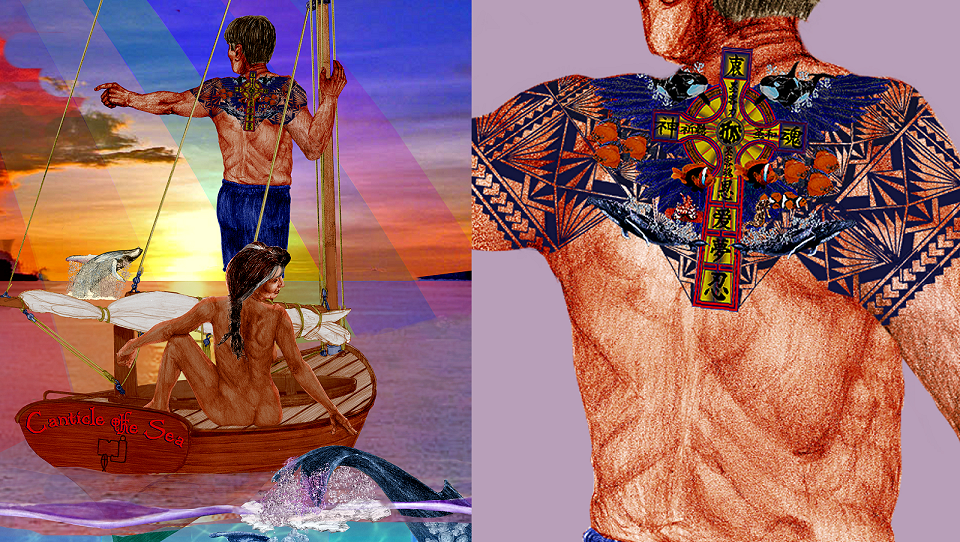 Not often seen detail from one of my favorite works,
Wooden Boat [Canticle of the Sea]
To be honest, I don’t comprehend the desire to tattoo oneself, particularly in places where one will never see the ink. I don’t object, I simply don’t comprehend. At least two of my three kids [3 of 5?] have ink, and I admire the art. I have yet to find an image I wouldn’t tire of, or more recently, wouldn’t grow out of…
So, the Church as become too accepting of people who live non-traditional lives… The author of that article has probably have never really understood Jesus.
A digression, hopefully the implication will be understood…
Genesis 18: 20-21, 23-25, 32
Then the Lord said, “The outcry against Sodom and Gomorrah is so great and their sin so grievous that I will go down and see if what they have done is as bad as the outcry that has reached me. If not, I will know.”
Then Abraham approached him and said: “Will you sweep away the righteous with the wicked? What if there are fifty righteous people in the city? Will you really sweep it away and not spare the place for the sake of the fifty righteous people in it? Far be it from you to do such a thing—to kill the righteous with the wicked, treating the righteous and the wicked alike. Far be it from you! Will not the Judge of all the earth do right?”
…Then he said, “May the Lord not be angry, but let me speak just once more. What if only ten can be found there?”
He answered, “For the sake of ten, I will not destroy it.”
Ezekiel 16:1-2, 48-50
“The word of the Lord came to me:
“Son of man, confront Jerusalem with her detestable practices…
“As surely as I live, declares the Sovereign Lord, your sister Sodom and her daughters never did what you and your daughters have done.
“Now this was the sin of your sister Sodom: She and her daughters were arrogant, overfed and unconcerned; they did not help the poor and needy. They were haughty and did detestable things before me. Therefore I did away with them as you have seen.”
Jesus said,
“If anyone will not welcome you or listen to your words, leave that home or town and shake the dust off your feet. Truly I tell you, it will be more bearable for Sodom and Gomorrah on the day of judgment than for that town.” [Mt 10:14,15]
There is something specifically missing from the above quotations about Sodom; something many in the Church seem unable to see. “Arrogant, overfed and unconcerned; they did not help the poor and needy. Haughty.” Sounds a lot like contemporary America.
No specific reference to sexual practice. It happened. That wasn’t why.
 http://www.pbs.org/wgbh/amex/weshallremain/
Tonight I finished watching “We Shall Remain”—the mostly-untaught story of America.
“In 2008, Religion and Ethics Newsweekly released a survey on how Americans view their country’s relationship to God: “Sixty-one percent agree that America is a nation specially blessed by God,” it revealed, “and 59 percent believe the United States should be a model Christian nation to the world.”
“Ever since Europeans came to America, the idea of the United States as a land of special blessings has animated America’s soul. John Winthrop, the Puritan governor of the Massachusetts Bay Colony, famously drew upon the Bible to describe the early New England settlers: “We shall be as a City upon a hill, the eyes of all people upon us.
“Subsequent generations have voiced similar themes to propel America’s narrative: their country was thought to have a “manifest destiny;” to represent “an empire of liberty;” to offer the “last best hope on earth;” and above all, to embody “American exceptionalism.”
by William Doino Jr.
http://www.firstthings.com/web-exclusives/2012/08/is-america-blessed-by-god
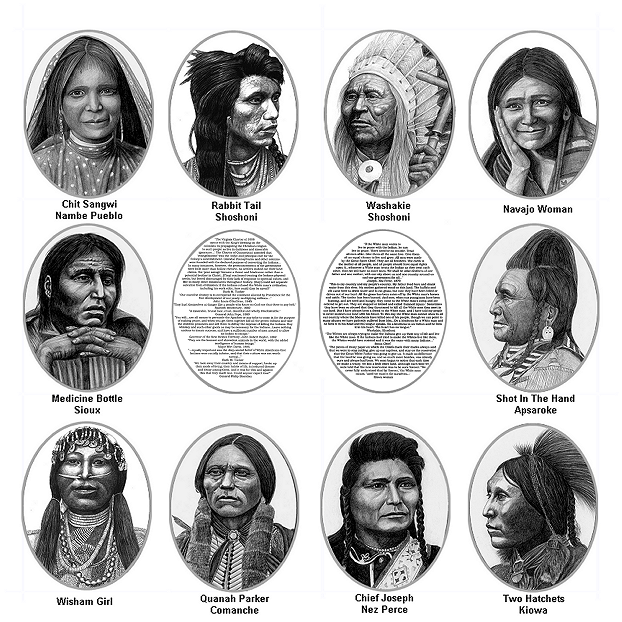
“The Master of Life has appointed this place for us to light our fires, and here we shall remain.” -Tecumseh (Shawnee)
Tecumseh to Governor Harrison (August 1810)
Brother, I wish you to give me close attention, because I think you do not clearly understand. I want to speak to you about promises that the Americans have made.
You recall the time when the Jesus Indians of the Delawares lived near the Americans, and had confidence in their promises of friendship, and thought they were secure, yet the Americans murdered all the men, women, and children, even as they prayed to Jesus?
The being within me hears the voice of the ages, which tells me that once, always, and until lately, there were no white men on all this island, that it then belonged to the red men, children of the same parents, placed on it by the Great Good Spirit who made them, to keep it, to traverse it, to enjoy its yield, and to people it with the same race. Once they were a happy race! Now they are made miserable by the white people, who are never contented but are always coming in! You do this always, after promising not to anyone, yet you ask us to have confidence in your promises. How can we have confidence in the white people? When Jesus Christ came upon the earth, you killed him, the son of your own God, you nailed him up! You thought he was dead, but you were mistaken. And only after you thought you killed him did you worship him, and start killing those who would not worship him. What kind of a people is this for us to trust?
Tecumseh to the Osages (1811)
Brothers, when the white men first set foot on our grounds, they were hungry; they had no place on which to spread their blankets, or to kindle their fires. They were feeble; they could do nothing for themselves. Our fathers commiserated their distress, and shared freely with them whatever the Great Spirit had given his red children. They gave them food when hungry, medicine when sick, spread skins for them to sleep on, and gave them grounds, that they might hunt and raise corn. Brothers, the white people are like poisonous serpents: when chilled, they are feeble and harmless; but invigorate them with warmth, and they sting their benefactors to death. The white people came among us feeble; and now that we have made them strong, they wish to kill us, or drive us back, as they would wolves and panthers.
Brothers, the white men are not friends to the Indians: at first, they only asked for land sufficient for a wigwam; now, nothing will satisfy them but the whole of our hunting grounds, from the rising to the setting sun. Brothers, the white men want more than our hunting grounds; they wish to kill our old men, women, and little ones. Brothers, many winters ago there was no land; the sun did not rise and set; all was darkness.
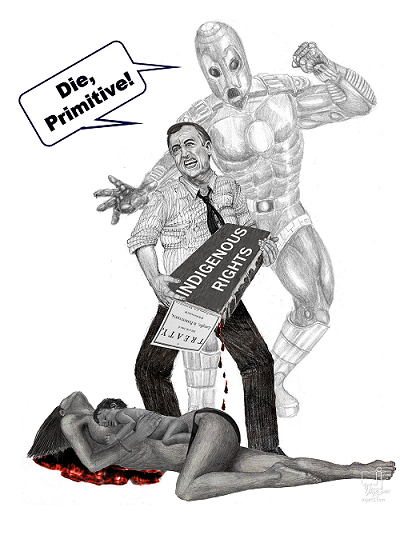
America, the “City upon a hill, the eyes of all people upon us.” We, who slaughtered the Nations who lived here before us; we who enslaved the African population who were brought here by force; we who placed the Japanese-American citizens of this country in internment camps, stealing their property. We who have a leading candidate for President who wants to remove all of the Muslim citizens of this country simply because they honor the Qur’an.
As an aside, the 93rd verse of chapter 4 (sūrat l-nisāa), of the Noble Qur’an states:
ومن يقتل مؤمنا متعمدا فجزاؤه جهنم خالدا فيها وغضب الله عليه ولعنه واعد له عذابا عظيما
“But whoever kills a believer intentionally – his recompense is Hell, wherein he will abide eternally, and Allah has become angry with him and has cursed him and has prepared for him a great punishment.”
Most of the people killed by the suicide bombers of ISIS and others, are Muslim. Those in ISIS apparently don’t read their Book anymore carefully than we do.
In the days of the Prophets of Israel, they understood that sometimes the land had been cursed, due to the behavior of the people. God was often silent for centuries…




 Chronicles in Ordinary Time