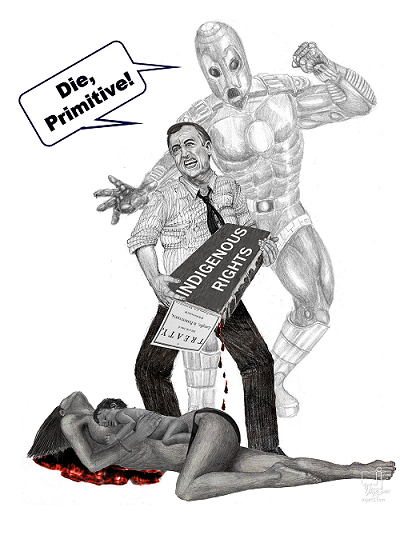
This illustration was created for Ken Gunther, for an upcoming book to be published by Gaiadigm Books.
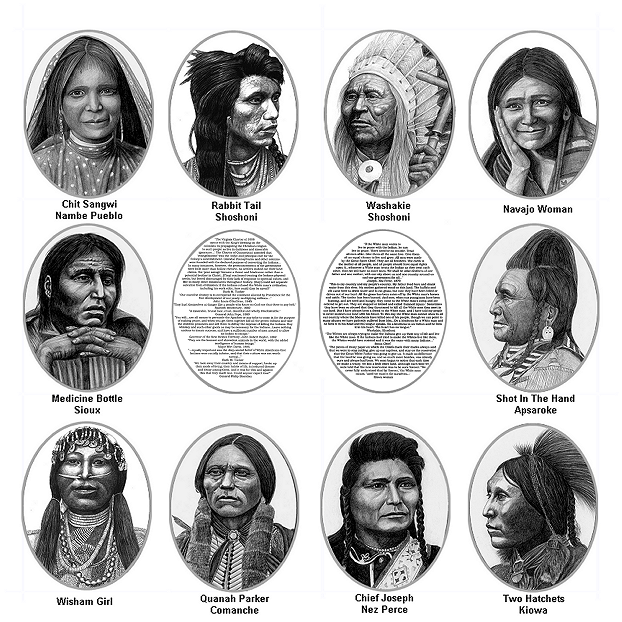
Somewhere in the eighties I started drawing Native American portraits, some of which were compiled in the image below [John_10-16]. The process of searching for new images became a study of our government’s treatment of the indigenous peoples who lived here before the Europeans came; and the slaughter of those Nations.
Nations. Our government recognized these peoples as Sovereign Nations, and prepared Treaties with these Nations; and then systematically broke all of the Treaties.
In the image below, the words in the oval on the left state that the purpose of most of the early colonies was evangelism; over time the presence of the Native Americans became an obstacle…
“Our manifest destiny is to overspread the continent allotted by Providence for the free development of our yearly multiplying masses.”
John Louis Sullivan, 1845
“In treachery, broken pledges upon the part of high officials, lies, thievery, slaughter of defenseless women and children, and every crime in the catalogue of man’s inhumanity to man, the Indian was a mere amateur compared to “the noble white man.” His crimes were retail, ours wholesale.”
Lt. Britton Davis, 1884
In the image below, the oval on the right offers quotations from half a dozen “Indians” who spoke words that should have come out of the mouths of Christians of that time. Words that echo what Jesus taught.
The Lakota used a metaphor to describe the Europeans who arrived on their lands.
“It was Wasi’chu, which means “takes the fat,” or “greedy person.” Within the modern Indian movement, Wasi’chu has come to mean those corporations and individuals, with their governmental accomplices, which continue to covet Indian lives, land, and resources for private profit.
Wasi’chu does not describe a race; it describes a state of mind.
Wasi’chu is also a human condition based on inhumanity, racism, and exploitation. It is a sickness, a seemingly incurable and contagious disease which begot the ever advancing society of the West. If we do not control it, this disease will surely be the basis for what may be the last of the continuing wars against the Native American people.”
…excerpt from Wasi’chu, The Continuing Indian Wars,
Bruce Johansen and Robert Maestas
with an introduction by John Redhouse
[ http://www.dickshovel.com ]
Evangelical Christians in the US seem to have a short memory. We talk about being a nation ‘blessed by God’ and overlook the slaughter of the Nations that were here at the beginning. We overlook Hiroshima and Nagasaki as crimes against humanity. And somehow we call our nation “blessed”. How can we justify these actions of the past as Christian actions?
The “Occupy…” movements of today, I believe, are a reflection of the some people’s recognition of the spirit of Wasi’chu among us. We live in a country of vast inequalities. I do not believe the answer is simply “redistribution of wealth”. When the wealthy refuse to be taxed at the same rate as the non-wealthy, at the expense of “social services,” I think we have a problem of Wasi’chu.
What Would Jesus Do?
I don’t know; the Gospels do not include any instances of “Occupy Jerusalem”. Jesus lived under the foot of an Emperor; and such movements would have probably ended with death and maiming.
In an interview with Gary W. Moon written in “Conversations
Journal” [ http://www.philipyancey.com/wp-content/uploads/2011/11/WhatGoodIsGod-Yancey-and-Moon.pdf ], Philip Yancey writes:
For one thing, Jesus didn’t live in a democracy; he lived under an occupying power, the most powerful empire of its time. In such circumstances, you can either accommodate the ruling power, as the Sadducees did, or violently oppose it, as did the Zealots. Jesus mostly ignored it. He said nothing about the brutality of the Romans or some of their nefarious practices, such as gladiator games, pederasty, and the abandonment of infants. His guiding principle, “[Give] unto Caesar the things that are Caesar’s, and unto God the things that are God’s,” is wonderfully ambiguous (Luke 20:25, ASV).
GWM: So, if you could write a one or two-sentence prescription for the
church in the US and you were sure it would be followed, what would you prescribe?
PY: Spend less time and energy trying to clean up the culture around you—a task Jesus and Paul did not seem concerned about—and more time and energy creating a counter-culture that presents a compelling alternative while exposing the shallowness of its surroundings.
I don’t think I can say it any better.