Posts Tagged ‘self-employment’

Chronicles in Ordinary Time 20: Freelancing

September 16, 2012

1950's fashion models

The images above are for a fashion-industry product launch that is supposed to happen in the near future.

A long time ago, in what seems like another lifetime, I was involved with a direct sales organization. While I had some talent for selling alarm systems and water treatment systems, it wasn’t a way of life that interested me. I had aspirations for the potential lifestyle, but in order to have that lifestyle,  I was trying to be someone that I  really did not want to be. I did gain some valuable insights into Life, and the experience changed me in a positive way.

One of the things I found most valuable was to find out whether or not an ‘expert’ really has any experience with the subject being taught, or whether the information comes from books and classes; and has never been practiced. I once met a man who was teaching a college class in Small Business. When I asked him about his experience, I discovered that his only ‘Small Business Experience’ was the Small Business classes he had taken in college. He’d never owned nor operated a small business. He didn’t have any life experience to pass on to others. But he was getting paid to teach students who wanted to learn how to run a small business. This doesn’t make sense.

When I started this blogging gig [a form of marketing], I decided that I would only write about things I’ve experienced; rather than attempting to present a picture of myself that isn’t real. The other night I spent a couple of hours retouching some images for a client– removing some unwanted inches and some unsightly cellulite. She’s using the images on a personal website; but the reality is that her published appearance will be an illusion. In our media-rich world of the present, it is very difficult to separate illusion from reality.

Back when dinosaurs ruled the earth, it never occurred to me to do much research regarding college and career paths. In high school I drew; and enjoyed technical illustration. I assumed that since I could do that in high school, I would be able to do the same thing in college. Bad assumption. When I arrived at Oregon State University, my only options for drawing as a major were architecture and art. I didn’t really want to spend my life drawing houses [I never had grand aspirations], and I’d always heard the term “starving artist”. Majoring in ‘starving artist’ seemed like a waste of time and money, so I chose architecture.

My first career, after my 5 years of college and my professional degree in Architecture, was construction. I soon learned that all that was needed for being a contractor was a pickup, a Black Labrador, a hammer and a Skilsaw. I never did find a Black Lab. I had children, instead.

In between careers #1 and #2, I worked briefly for an architect; and confirmed that I didn’t want to spend my life drawing houses– more specifically, apartments. And yet, career #2 found me reviewing house plans for Building Permits. I eventually ‘graduated’ to high-rise buildings and block-square commercial developments. Life is humorous…

On doctors’ orders, after 14 years with the City, I moved on to career #3–that of a Building Code/architectural consultant; and freelance commercial artist/illustrator. My self-description varies with the month and the nature of the work I’m doing. At present, “commercial artist” is the favored description. Partially because no one uses that terminology anymore…

I really can’t recommend the life of a freelance commercial artist. Generally, it sucks. I spend far more time marketing myself than actually earning any money. The images above were ‘pro-bono’–the only income I might derive is from referrals somewhere down the road. Someone else, in theory, will earn some money because I created the images. However, I volunteered for the opportunity,  so I’m not really justified in complaining. I would prefer a world where I got paid for the hours involved in creating the images.

I never have tried to get a job as an illustrator/commercial artist. I’ve learned that I really don’t make for a good employee; I’m too opinionated about my work. I don’t like being told to create something I disagree with. Sometimes I have to make design decisions I don’t like, but I do it voluntarily, rather than by being told to, ‘do it, or else… ‘ I prefer the option of choosing to decline the opportunity.

I was paid for the images below. They are images that are in the background of a much larger composition– “extras” in Hollywood terminology. The scene in which they are present is based on  a scene from the movie “Titanic”. The cast was selected from people in my portfolio; images created for other purposes. I wasn’t paid much for these particular images, but I was paid to draw while watching a movie. Can’t beat that.

I spend 2-3 hours per day trolling Craigslist; looking for ‘creative gigs’ across the country. I often spend an hour or two adapting a prior illustration to fit with a particular job description that interests me. When I was a Building Contractor [CEO of a corporation, for that matter], I was taught that a 4% return on a mass marketing campaign was a good return. 4 out of 100; more accurately, 40 out of 1000. One might have to go through 900 rejections before the first positive response is received. That’s a lot of rejection, if one looks at in that manner. It’s better to simply regard it as valuable information, and the cost for a success.

My experience with freelance illustrating is fairly similar. I think I get more favorable responses than 4 our of 100 jobs I inquire about.  It might even be as high as 10%. I don’t do the math; it can be discouraging. Out of the jobs I do get responses for, I probably earn something similar to minimum wage, if I count every hour I invest in a project. However, not every hour is a justifiably billable hour. Sometimes I have to do a lot of experimenting to finally arrive at an idea that works. Billing a client for experimenting is probably justifiable, but at the end of a day of experimenting, I might not have anything of value to show the client for that day’s work. I try to base my fees on what I think an outcome is worth, rather than the amount of time invested on my part. Not necessarily a smart way to do business, but I rarely have clients who complain about my work.

It would be smarter to get a job; and I’m continually thankful for the retirement income I earned from my 14 years working for the City. We manage; and we’ve had to live a limited lifestyle. We don’t travel, we don’t eat out much; we rarely go to concerts or do activities that cost money to attend. We don’t buy stuff that we really don’t need.  For some, this would be intolerable. For those who want to live the lifestyle advertised on television: don’t become a freelance artist.

Chronicles in Ordinary Time 17: This is what I am here to teach—a mystery!

June 4, 2012


As I write this, I’m watching a biography of Audrey Hepburn. Watching the images go by on the screen, there are so many that are familiar. I illustrated a biography of hers several years ago; a ‘work for hire’ job for which I was paid; but never saw in print. One of my projects that did not go well. Portions of the illustrations went well, but overall, the book’s illustrations flopped. As usually happens when I illustrate a book, I became immersed in her life, searching the Internet for photos, and watching her films; all in a space of a few weeks. Watching her story after all these years is a strange déjà vu.
Judy and I were on our way to Denver, Colorado, to attend Rob’s graduation from Johnson & Wales University. I planned on working on the illustrations with my portable drawing board, scanning the drawings at Kinko’s, and manipulating them on my laptop. My laptop decided to crap out on me during the trip; and most of the illustrations had to get finished after we returned home, by working 16 hours a day for 2 weeks, in order to meet my deadline. As it happens whenever I have to work in a rush, things did not go well, and I had no time for making better versions of the images… I delivered my illustrations on time, I got paid, but received little satisfaction from the project.

    “All of life is a mystery, but the answer to the mystery is outside ourselves, and not inside. You can’t go on peeling yourself like an onion, hoping that when you come to the last layer, you will find what an onion really is. The mystery of an onion is still unexplained, because like man, it is the issue of an eternal creative act. I stand in God’s shoes, but I can’t tell you any more. Don’t you see? This is what I am here to teach—a mystery! People who demand to have all of creation explained from beginning to end are asking the impossible. Have you ever thought that by demanding to know the explanation for everything are committing an act of pride?  We are limited creatures. How can any one of us encompass infinity?”

Pope Kiril I, The Shoes of the Fisherman; Morris L. West

…I got paid, but received little satisfaction from the project… I wanted a ‘do-over’, but didn’t have the chance. A lot of the people in my life are going through difficult times right now; myself included. Doesn’t seem right, doesn’t seem fair, we want a ‘do-over’. As they were growing up, I often told my children that ‘life is hard; then you die’. This is my third career, the first two not ending as well as I’d have liked. The line, “…and they lived happily ever after…” hasn’t been the story of my life. Until I reflect upon the lives of others…
    A scene from a Hiroshima Diary, another project that didn’t work out; again because of an unreasonable time line. The above illustration was a gift. I was compelled to create the drawing above, the product of a drawing marathon, and I felt the Hand of the Creator guiding me. Unfortunately, I had to earn a living while working on the project, and I could not devote the concentrated time that I had with the first illustration. The story, written from the reflections of a woman still living in Japan, tells the story of a teacher who returned to Hiroshima a few days after the bomb, looking for her niece and nephew. Throughout the story she meets other children, all of whom die in her arms, from radiation poisoning. Children everywhere, separated from their parents or huddling by their deceased parents. The teacher brings a final blessing to their short lives. A part of our ‘proud American history’ that never gets told…
One of the reasons why I watch so many movies is to enter into the stories of other people. I prefer living my life in my cave, rather than interacting with others; at the same time I realize that my Creator made me as a person who needs other people in my life, in order for me to grow. When I was in college I was told repeatedly that “God has a plan for your life;” and I’ve always wondered whether I was really following that plan. My desire has been to follow that plan, and my desire has been to live the life I felt led to follow. My assumption, based on things I’d heard from platforms and pulpits, was that my life was supposed to work out well—by my definition of well. In truth, my life has worked out well; but I suffer from the Human Condition, I suffer from envy. I want my life to work out like some other people’s lives have worked out. Funny how we rarely envy those who live in tin- or cardboard shacks. I’ve met people who live in tin- or cardboard shacks, and have been learning that happiness does not depend upon the things with which we clutter our lives.

Some people are content with not asking questions about their lives; some people have no questions to ask.

    These lives remind me of the fact that I am blessed. I’m angry with my dissolving body; I’m angry about the stupid financial decisions I made when I didn’t realize that the economy was going to collapse. And yet, I have a roof over my head; my children have roofs over their heads; I’ve been married to Judy for 36 years [in a couple of weeks]; my career with the City earned a small pension that pays a lot of our bills. I can create images that have meaning for me.
Life is a mystery. Sherlock Holmes isn’t around to answer all of the questions for us. We have to live with the questions until we get Home. A lot of people claim to have answers to the questions, and I suppose it’s a good thing that these answers work for them. Unfortunately, a lot of the answers aren’t as universal as they believe.


Chronicles in Ordinary Time 16: only you can know if the price is worth the stress

May 20, 2012

Every now and then I get paid to have fun. A client wanted some ‘bots’ for his PowerPoint project, so I was able to design ‘bots’. I wanted to avoid ‘feet’ since we’re in the 21st Century, but the client didn’t seem to understand plasma jets. In the time-honored tradition of animated robots, all of my bots were created from ordinary household objects…

Our pastor reminded us this morning of the importance of joy in our lives. That’s why Christ came to space/time as the incarnated Creator; to help us find joy in our lives. The Church has messed that up for the last couple of millennia, because rules are easier than freedom. I needed to hear that message today, because I’m still beating myself up for once again succumbing to one of my perennial temptations–one that has cost me dearly over my life. I have the ability to willingly abuse my body with overwork, in order to accomplish goals that I set for myself; substituting self-medication for common sense. This last week it was 6 hours of sleep in 48, I think, in order to finish a project by a totally unreasonable deadline. But I wanted the money that the job would bring.

Richard Jesse Watson, a very wise man, once told me, “You can get quality, speed, and inexpensive but not all three at once. In other words, if they want it fast and cheap, fine, but they can’t expect quality. If they want fast and quality, fine but it won’t be cheap. If they want cheap and quality, that too is possible, but it shouldn’t be expected fast, as it might be more of a favor or gift.
If it is something that you feel you need to do for you, then only you can know if the price is worth the stress.”


Chronicles in Ordinary Time 15: wormholes

March 26, 2012

I spent [wisely] several hours today watching the Science Channel’s “Through the Wormhole;” an overview of quantum physics, cosmology, astrophysics and the history of modern science. I don’t have any other space images in my collection of illustrations…

As they were growing up, I advised my kids of a saying I learned in my ‘hippie’ days [I can remember the 60’s & 70’s; consequently I wasn’t really there]. “Whatever you own, owns you.” This includes the ownership of indebtedness. If my life had been different, I would be ‘semi-retired’ by choice, at this time rather than by circumstance of economy.  My 14 years with the City were an investment I didn’t understand, and keeps a roof over our heads during this uncertain time. Nonetheless, my indebtedness means my wife and I still need to be employed, rather than enjoying the early retirement of some of my colleagues.

If I had the time to create the illustrations I want to create, instead of focusing my time on trolling Craigslist, I’d have more ‘space’ images.  I loved science fiction novels growing up; now I enjoy [some] sci-fi movies; I can go through a story in two hours. My current reading is classic novels, and they take a long time, due to the  limited amount of time I allocate for recreational reading.

A lot of religious folk get really spooked by cosmology. They’ve been taught to read the Bible as a literal textbook for science and history; rather than as a journal of the Eternal’s interactions with a family line of humans. The Richard Dawkins’ of the world find solace in mathematics and physics; and decide that since they find evidence that the universe can exist without a Creator, it must be so. ‘The need for a Creator’ coming from propaganda. I look at cosmology as an attempt by very finite, very limited human beings to understand the language of the Infinite and Eternal Creator of everything. A mentor of mine taught me that the Bible is, in reality, God’s ‘baby talk’ for his ignorant children.  I’ve never understood the Eternal to be some sort of ancient grandfather figure who occasionally entertains his descendents with magic. That’s probably because I had a personal encounter with the Creator during a period when I was in my twenties; and everything since then has been the ‘acquisition of background’ more than following parental teaching. I had none.

So, I’m fascinated with astrophysics and cosmology. I’m also fascinated with theology. Moses Maimonides, a Jewish rabbi of the 12th Century, taught that, at the Beginning,  all of the material in Creation was condensed by the Eternal into the space of a mustard seed; and was rapidly ejected outward into the heavens. The Expanding Universe, 400 years before Galileo. Maimonides found this information in his extensive study of Holy Torah. He also taught that the first letter of Torah, in Hebrew was closed in the backward direction; there was no reason to seek out what happened before Creation. He hadn’t run into many modern cosmologists.

I’m revisiting Stargate SG-1; a sci-fi show of the nineties[?]. I’d forgotten how much I enjoyed the series. And I enjoy the references to Star Trek and Star Wars. I’m continually impressed at the way that science fiction and science fact interact and depend upon each other.

Thou hast made us for thyself, O Lord, and our hearts are restless until they find their rest in thee..” Augustine

Chronicles in Ordinary Time 14: the right thing to do

March 12, 2012

I’m a fan of [some] Samurai and Kung Fu movies… Japanese/Chinese Westerns. Unlike American Westerns, in these movies, the hero usually dies.
Today I watched Mibu gishiden / 壬生義士 / “When the last sword is drawn”; a story set in the late 1800’s, near the end of the Shogun period of Japanese history, when the Emperor was gaining power. In many ways the story has similarities to “The Last Samurai” in that it deals with the change from traditional Japanese life to the transition into the Age of the West. Interestingly, in an interview with the author of the novel from which the movie was made, he said that he wrote the story, in part, to remind his countrymen that they were still Japanese. “Sometimes I think we are half-American.”

The story tells of the Shinsengumi, described by the author as ‘dropout’ Samurai–mercenaries protecting the Shogun; and in particular, “Kanichiro Yoshimura, a Samurai and Family man who can no longer support his wife and children on the the low pay he receives from his small town clan. He is forced by the love for his family to leave for the city in search of higher pay to support them…” [C. Maginnis ]
Despised by his clan, the story tells of how he is truly an honorable man.

I enjoy these stories involving violent men and women, not for the violence, but for their stories of honor, bravery, sacrifice and decency. Stories that tell of the importance of tradition, family and keeping one’s word.

I also love the craftsmanship found in the sets for these stories. In my other life as an architectural/Code consultant, I recently had the pleasure of visiting a Historic Federal building in Old Town; a building that was clearly built in a different age; the ‘age of decoration’. Standing on the roof of the building, near a section where a higher roof overlapped; I saw that on the underside of this roof overhang, 4ft above the roof I stood upon, where only maintenance people would ever see, were cast ‘rosettes’ about a foot in diameter. I’m always amazed/intrigued when I see carving on the roofs of tall, old buildings. Decorations placed where few will ever notice. Placed there because it was the right thing to do.

I spent several hours on Thursday, Friday and the weekend editing and re-editing a video ad that should have only taken a few hours to complete. It took me 5 [delivered] tries to get it right [many more, undelivered]; and demonstrated to myself that it’s possible to go from moderately skilled to inept, in a matter of several months of inactivity. On my last delivery, I told the client to ignore my bill, because I was embarrassed by my performance. I expected the job to pay me for two hours of time; it probably took 10 or more. He offered to pay me for an additional two hours, so I delivered a larger bill with my 4th try, finished at 4:30a yesterday. While I remember watching the 4-part, minute-long promotional ad, I somehow missed the fact that I had put part 4 at the beginning as well as at the end. So I ended up sending the clientt a larger bill for something that wasn’t even acceptable…

I decided, when I was younger, that when I got older, I wouldn’t be one of those people who complain about their health all the time. So I avoid telling people much about this *interesting* time of my life. At the same time, I try to live transparently, and in such a manner that I can offer some wisdom [which only comes from experience, which mostly comes from lack of wisdom]. 80-90% of my sensory nerves are gone. My motor nerves seem to mostly be unaffected, but my brain has to work overtime to enable me to keep my balance, and other details. As much as I hate to admit it, I think the stress of my new life causes me to lose focus more than I’d like. I have more trouble finding words, and being able to express words, than I did a year ago. I make mistakes I didn’t make a year ago…

It would be ‘easy’ to simply quit, and decide I just couldn’t cut it any longer. I have a small pension, the equivalent of a low-paying job. And a really large debt load from 12 years of self-employment, most of them pre-pension. In many ways it would be ‘easy’ to just  idle away my hours watching movies all day. To do that would be [in my eyes] dishonoring me, dishonoring my family and dishonoring my Creator [not necessarily in that order]. I believe that my Creator loves me in spite of my failures and successes; I am blessed to have a family that believes similarly. Then there’s that other guy, the one in the mirror. He is the hardest to please. Fortunately, he was shown Grace and Forgiveness a few decades ago.

Prayer, Placebo or Prozac? I was diagnosed as ‘clinically depressed’ back in the nineties; but was either not offered a medical alternative; or was too proud to admit that it could help. I’ve finished my first week on Prozac, in theory too soon to expect much improvement. Last Thursday was the first ‘good’ day I’ve had in months. I still had all of my aches, pains and losses, but they were easier to bear/I had more energy. There are a lot of people who have me on their prayer lists. Improvement from the expectation of a pill’s working is a known medical phenomenon. Friday and Saturday were ‘new normal’–uncomfortable, but not crummy; as the last months have been.

All of this  brings me back to hero movies. Examples that show there are some things worth sacrificing one’s life for. Reminders that struggle can be worth the pain it causes. Reminders that it’s worthwhile to live for something larger than me.


Chronicles in Ordinary Time 9: Occupying Our Hearts

November 13, 2011

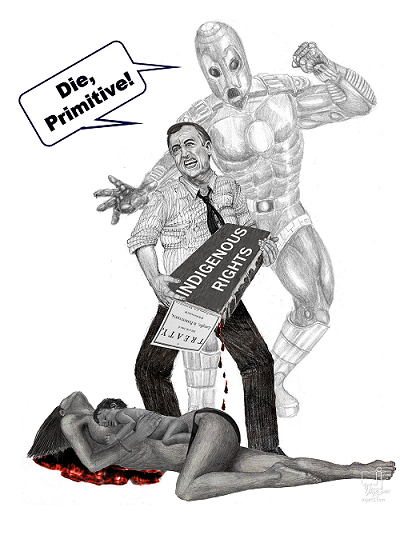
This illustration was created for Ken Gunther, for an upcoming book to be published by Gaiadigm Books.

Somewhere in the eighties I started drawing Native American portraits, some of which were compiled in the image below [John_10-16]. The process of searching for new images became a study of our government’s treatment of the indigenous peoples who lived here before the Europeans came; and the slaughter of those Nations.

Nations. Our government recognized these peoples as Sovereign Nations, and prepared Treaties with these Nations; and then systematically broke all of the Treaties.

In the image below, the words in the oval on the left state that the purpose of most of the early colonies was evangelism; over time the presence of the Native Americans became an obstacle…

“Our manifest destiny is to overspread the continent allotted by Providence for the free development of our yearly multiplying masses.”
John Louis Sullivan, 1845

“In treachery, broken pledges upon the part of high officials, lies, thievery, slaughter of defenseless women and children, and every crime in the catalogue of man’s inhumanity to man, the Indian was a mere amateur compared to “the noble white man.” His crimes were retail, ours wholesale.”
Lt. Britton Davis, 1884

In the image below, the oval on the right offers quotations from half a dozen “Indians” who spoke words that should have come out of the mouths of Christians of that time. Words that echo what Jesus taught.

The Lakota used a metaphor to describe the Europeans who arrived on their lands.
“It was Wasi’chu, which means “takes the fat,” or “greedy person.” Within the modern Indian movement, Wasi’chu has come to mean those corporations and individuals, with their governmental accomplices, which continue to covet Indian lives, land, and resources for private profit.
Wasi’chu does not describe a race; it describes a state of mind.
Wasi’chu is also a human condition based on inhumanity, racism, and exploitation. It is a sickness, a seemingly incurable and contagious disease which begot the ever advancing society of the West. If we do not control it, this disease will surely be the basis for what may be the last of the continuing wars against the Native American people.”
…excerpt from Wasi’chu, The Continuing Indian Wars,
Bruce Johansen and Robert Maestas
with an introduction by John Redhouse
[ http://www.dickshovel.com ]

Evangelical Christians in the US seem to have a short memory. We talk about being a nation ‘blessed by God’ and overlook the slaughter of the Nations that were here at the beginning. We overlook Hiroshima and Nagasaki as crimes against humanity. And somehow we call our nation “blessed”. How can we justify these actions of the past as Christian actions?

The “Occupy…” movements of today, I believe, are a reflection of the some people’s recognition of the spirit of Wasi’chu among us. We live in a country of vast inequalities. I do not believe the answer is simply “redistribution of wealth”. When the wealthy refuse to be taxed at the same rate as the non-wealthy, at the expense of “social services,” I think we have a problem of Wasi’chu.

What Would Jesus Do?
I don’t know; the Gospels do not include any instances of “Occupy Jerusalem”. Jesus lived under the foot of an Emperor; and such movements would have probably ended with death and maiming.

In an interview with Gary W. Moon written in “Conversations
Journal” [ http://www.philipyancey.com/wp-content/uploads/2011/11/WhatGoodIsGod-Yancey-and-Moon.pdf ], Philip Yancey writes:
For one thing, Jesus didn’t live in a democracy; he lived under an occupying power, the most powerful empire of its time. In such circumstances, you can either accommodate the ruling power, as the Sadducees did, or violently oppose it, as did the Zealots. Jesus mostly ignored it. He said nothing about the brutality of the Romans or some of their nefarious practices, such as gladiator games, pederasty, and the abandonment of infants. His guiding principle, “[Give] unto Caesar the things that are Caesar’s, and unto God the things that are God’s,” is wonderfully ambiguous (Luke 20:25, ASV).

GWM: So, if you could write a one or two-sentence prescription for the
church in the US and you were sure it would be followed, what would you prescribe?
PY: Spend less time and energy trying to clean up the culture around you—a task Jesus and Paul did not seem concerned about—and more time and energy creating a counter-culture that presents a compelling alternative while exposing the shallowness of its surroundings.

I don’t think I can say it any better.