Posts Tagged ‘surviving’

Chronicles in Ordinary Time 80: They Changed the World

September 18, 2015

your life isn't about you PKDYour life is not about you.

A guy I know would say that the above statement is absurd; of course his life is about him. To his mind, there is nothing more in life than his life. Nothingness follows his life. What will be left behind from his life [from my perspective] is a bunch of broken relationships; because, his life is only about him…

Your life is about others.

You will be remembered for what you did for, or to, others. If your life has never been about others, or has only been for others as some benefit to your own life, then your life has been wasted. You may be remembered, but not fondly.

This wasn’t the message I was raised with; it took a lot of effort for me to understand. Looking back, it didn’t seem like effort; I wanted to live my life in a way that I wasn’t seeing very often in this world; and I realized I needed new information.

Fortunately, there are far more people in this world who choose to be remembered because they did something positive for another person, rather than by choosing the negative.

Our American society tends to make villains into celebrities; mass murderers who somehow become celebrated for the pain they inflicted on others. Because we tend to make villains into celebrities, those who have been given no real value by the ‘others’ who raised them feel that “15 minutes of fame” as a monster, somehow equates with a life that has meaning. They were here; they made a statement. When historians look back, they will find the tale of a monster…a person remembered because they were ‘bold’ as a monster… Maybe there will even be a cable television series about his exploits…

How many lives have you saved by the simple act of driving safely? We may never know until we arrive at Home. It’s easier to count the damage done while driving with our minds elsewhere. We generally don’t get credit for doing a job ‘well’—the way the job is supposed to be done. The reality is that the reason for driving well is others. Not to avoid traffic tickets; not to see if you can manage to avoid getting caught; driving well is a gift you give to others. Doing your job well is a gift you give to others.

Your life is not about you.


This week I watched the PBS biography of Walt Disney on American Experience. I would not have enjoyed working for Disney; although a part of me wishes that I had left Eugene, Oregon in 1975 and headed for Los Angeles, to work full-time as an illustrator. In the late 1930s Disney’s crew worked 12-18 hour days in order to complete Snow White on time; the background painters, inkers and ‘in-betweeners’ worked for minimal pay [it was the Depression, and most of the painters and inkers were women—‘any knucklehead can do that job’]; while the ‘creative talent’ was paid well for their work. In the years following World War II, Disney employees went on strike for higher wages, wounding Disney deeply; this forever changed Walt’s vision of the world he wanted to create. As with many creative geniuses in the Art world, Disney was a tyrant, who had an entirely different persona displayed on camera, and with his family.

To a degree Disney’s life was about others; but for the most part, his life was about him. His highest praise, in general, was ‘that will work’. He chose a career that depended upon people liking what he created. The struggle every commercial artist faces, regardless of the form in which the art appears.

If one provided Walt with what he wanted, on time and in good order, Walt was a friend. He wanted the Disney studios to be ‘families’ [albeit dysfunctional ones]; with himself as the father, and his artists as ‘his boys’ [gender bias noted]. Loyalty was rewarded; disloyalty was not permitted.

In 1937 he premiered that which his detractors called, “Disney’s Folly”: Snow White and the Seven Dwarfs”. The movie that changed animation forever. The movie that proved that ‘a drawing can make an audience cry’. The wonder of those early images is lost on modern viewers; we’ve become accustomed to sophisticated imagery.

When I heard the words, ‘he wanted to prove that a drawing can make an audience cry,’ a chord was struck in my ‘heart’. While I’ve never used those words, I can understand them. I’ve had ambitions of artistic immortality. I doubt that this will happen.

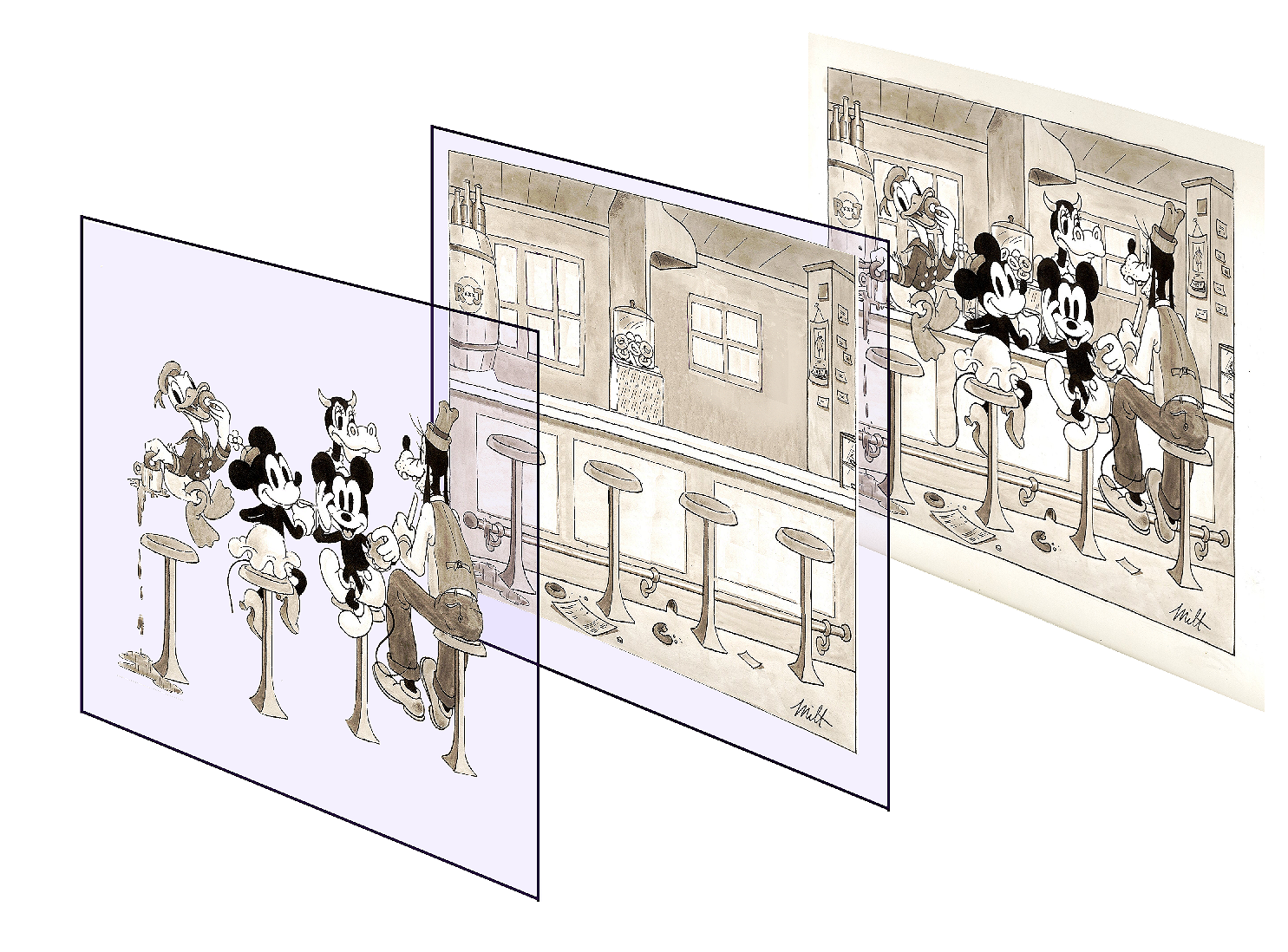
mickey's cafeI apparently had a relative of some sort, a guy named Milt, who worked at Disney Studios sometime in the past. Hanging on my wall is a drawing that I inherited from my Grandmother, after we moved her out of her house in a little town in Eastern Oregon. An original ‘Disney’ drawing—probably a personal project. I used the image to explain the concept of layering in digital art, the great tool that makes Adobe Photoshop the ‘giant’ it is; the digital giant that the .psd file is. A digital algorithm that enables ability to create a ditital drawing using transparent layers—the digital equivalent of the ‘cels’ [celluloid sheets] Disney used to create his animations. Disney created his early animations by photographing layers of transparent cels, which gave his animations the illusion of depth.

After the post-war strike, Disney’s enthusiasm for creating ‘art’ rather than making cartoons, disappeared. He started turning his real interest to television, while his studio continued to turn out feature films. Eventually his interest turned to Disneyland.

Walt Disney touched everyone in America who has lived in the 1950’s and beyond. I realized this week that Disney was foundational to my early life. I grew up with a television as a babysitter [two working parents]; and Walt Disney provided a lot of my entertainment. He also told me about my ‘history’—a white, conservative, ‘American Dream’ history. I think Disneyland was still new when my parents took me there, along with a million other white, conservative, American families. The Disney version of American history omitted “Manifest Destiny” and the genocide of the people who were here before the Europeans arrived, in Frontierland; ignored Slavery and Civil Rights in Fantasyland; and the Atomic Bomb in Tomorrowland; and all of the atrocities carried on by the real version of American history.

The Disney version of the world created some of the most enduring stories in American culture. Many today want to return to that world—one that really didn’t exist beyond parts of rural America. A vision of small town America that didn’t translate well into the urban environment. Geographically, America is mostly made up of rural towns; in terms of population, America is mostly made up of urban-dwellers. Cities where knowing your neighbor takes a lot of effort [more effort than I want to put out].

In spite of all of his cultural shortcomings [against the advice of the NAACP, Disney’s Song of the South was filled with ‘darkies singing happy songs;’ and premiered in Atlanta, where the story’s hero, ‘Uncle Remus’ was not allowed into the all-white theater], the truths his stories tell told remain true: if you live for others, you’ll find a reason for your life.

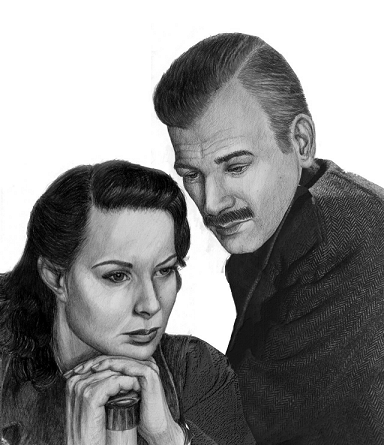
Audrey p22-23From an unpublished biography of Audrey Hepburn

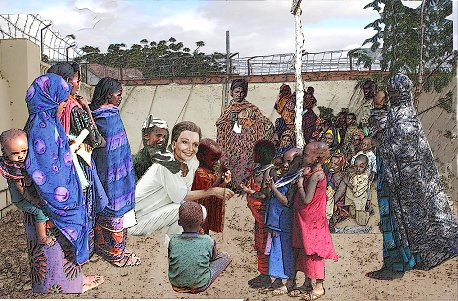
Audrey Hepburn was a sensation in Hollywood in her day. Surviving privation in Belgium during World War II, she emigrated to the UK to study ballet. Life being what it is, she instead became an actress, a virtual ‘overnight success’ after her role in Roman Holiday, opposite Gregory Peck. After she retired from movies, she devoted her life to UNICEF. My guess is that her impact as UNICEF’s ambassador far outweighed her career as an actress. Her life had taught her that her life was not about her.


Go back

Your message has been sent

Warning
Warning
Warning
Warning

Warning.

Chronicles in Ordinary Time 76: It’s always too soon to quit…

August 10, 2015

peacock window

A dear friend of mine recently posted some quotations from Marcus Aurelius on Facebook; a mutual friend, a woman we don’t know all that well, in reading his post remembered inspiration she received by reading the writings of this this long-dead Roman Emperor; and baby Aurelia was given her name. In the annals of history, being the instrument of the naming of a child is probably a small thing; however, she is only a few weeks old, and has her entire life ahead of her. Who knows what the inspiration from a Roman Emperor of 1900 years ago might have upon her life? The naming of each of our children was a well-thought-out experience, and I imagine it’s the same for many parents. We can never overlook the possibilities that our smallest acts contain.

This dear friend of mine has a lot of reasons for doubting the value of his life; he battles a chemical imbalance in his brain; probably a result of genes—something he cannot control. One of my ‘fears’ is that one day the chemistry will win out over what he knows in his heart-of-hearts to be true. When such ‘fears’ come upon me, I turn them over to the Author of Life, in whose name my dear friend was raised. Whatever events happen in our earthly lives, I know that we will meet again in the Life to Come. This is a promise from the Author of Life.

Sixty-three years of life; forty-two of them walking with the Author of Life. I rather wish I’d kept a list of the ‘small things’ that have happened in my life that ended up being extremely significant. Many of the ‘small things’ were barely noticed; like the song that just happened to start playing as I’m writing this paragraph [statistically, a 1/1340 chance]—The Impossible Dream, which caused to realize that there is more to live for in this life than the stuff we find around us. The story of the ‘Man of La Mancha,’ presented in a Senior AP English class in high school by “Captain Bob” Bonniwell opened the door to faith in my life. The older I get, the larger the pile of ‘stuff’ gets, and the more potent-smelling it becomes. And still I contend that it is better to live life as it could be, to live life as it ought to be lived; rather than to live life as it often presents itself in our circumstances. I never made the opportunity to thank Captain Bob. Should have.

I’ve been fortunate enough to be able to create a life for myself that allows me a lot of time to think, to ponder, to hope and to dream. The dreams are harder now, partially because the Dreambuilders I once surrounded myself with aren’t around. But I still am able to ponder and hope. I too often fail to realize what a gift my lifestyle has become for me. Most people have little time to think about LARGE concepts, such as faith. I wish I had the ability to download faith into all those who need it; I’d post it in a Dropbox and plaster the URL across the internet. Sadly, I can’t do that. By “faith” I’m not talking about religion; it often starts with religion; however, there is a Faith that transcends religion. I’m not there yet, but I can see it in the distance.

One of our shortcomings as human beings is that we tend to think that we are something special; just by being human. In today’s world, “American Exceptionalism” is probably the most insidious version of this curse—at least within the American culture. I believe that when the Creator said, “let us make man in our own image,” the Creator wasn’t talking about form. I believe that the gift we were given, that gift which is in the Creator’s image, is our ability to Create. There are other creatures that use tools; creatures like the spider that can build a web we can’t even begin to replicate—and these abilities are hard-wired into their tiny brains and neurological systems. Birds make nests; I don’t know if there are birds who have realized that all that plastic garbage we leave lying around can become weather-proof roofs over their heads…

We have the ability to create our own realities; and by this gift we are human, slightly lower than the angels. As animals, humans display a lot of behavior that is far from special. We are more than animals.

I’m in an *interesting* place in life. I don’t have ALS—it’s clear that I don’t have ALS—and yet I can’t help but wonder if what I experience is similar to those with ALS: watching my body ‘dissolve’ around me. I end most evenings [early mornings to much of the world] watching ‘hero stories’ on DVD. I find that drawing-time seems to work best after 10p or 11; and lasts for 3-4 hours; after which it simply hurts too much to keep sitting down. So I move to the couch, and watch a couple hours of ‘hero’ stories; and then I try to figure out how I’m going to get off of the couch, and make my way to bed. I was at a friends’ house yesterday, and sat down on a footstool; I immediately realized that this was a bad choice, because the footstool turned out to be much squishier than I expected it to be. When it was time to leave that room, I waited until I was the last one there, so I could figure out what method I’d use to get myself from footstool to standing up… I honestly can’t tell if it’s a strength issue or a function [lack of] issue. Getting up from the footstool was awkward, and I am innately self-conscious.

There are a couple of old guys in my life, guys who cannot [yet] cope with the idea of ‘new normal’—a new set of conditions in their lives that make their former plans extremely difficult to achieve. Neither of them live with the difficulties that one of my heroes lives with; a woman who has lived most of her life in a wheelchair, with a body that mostly does not respond to her control. She’s endured more operations than she has years in her life. Her physical abilities are far less than those of the two old codgers I’m writing about; and yet they have trouble finding a reason to stay alive. My hero-friend has been making that choice for a long time.

We make choices as to how we will live our lives. Some of us have horrible crap to overcome; some of us merely have inconvenience to overcome; and we think that it’s ‘horrible crap’ because our view of life is too small… Each day above ground is a gift, whether or not we want to see it that way. And we are given tremendous flexibility as to how we will use this gift.

How will you use your gift, today?

How will I use mine?

Summer King

Go back

Your message has been sent

Warning
Warning
Warning
Warning

Warning.

Chronicles in Ordinary Time 75: The Shadow People

July 17, 2015

Human Shadows Imprinted by Nuclear ExplosionHuman Shadows Imprinted by Nuclear Explosion

 I had planned on writing something more upbeat for this installment; I don’t like writing about the physical challenges I deal with—there are so many, with so many more…The hope, in writing the last installment, was that it might prove helpful for someone…

Then I was informed of the date: July 16, 2015, the 70th Anniversary of a horrific event.

On July 16, 1945, scientists in Los Alamos successfully exploded the first atomic bomb at the Trinity test site, located in nearby Alamogordo, New Mexico. The atomic age began; and the words were uttered by Robert Oppenheimer: “I have become death, the destroyer of worlds”. On August 6 and August 9—next month—the 70th Anniversary of the bombings of Hiroshima and Nagasaki will occur. The above images are from these cities; the shadows left on structures after their owners were vaporized by the atomic blast.

 Atomic_bombing_of_JapanAtomic cloud over Nagasaki from Koyagi-jima

 Wednesday afternoon I opened my email to find that people are suggesting that we go to war with Iran; for fear that Iran will become a nuclear power, and will provide terrorists with nuclear capability. The insanity of nuclear war must stop.

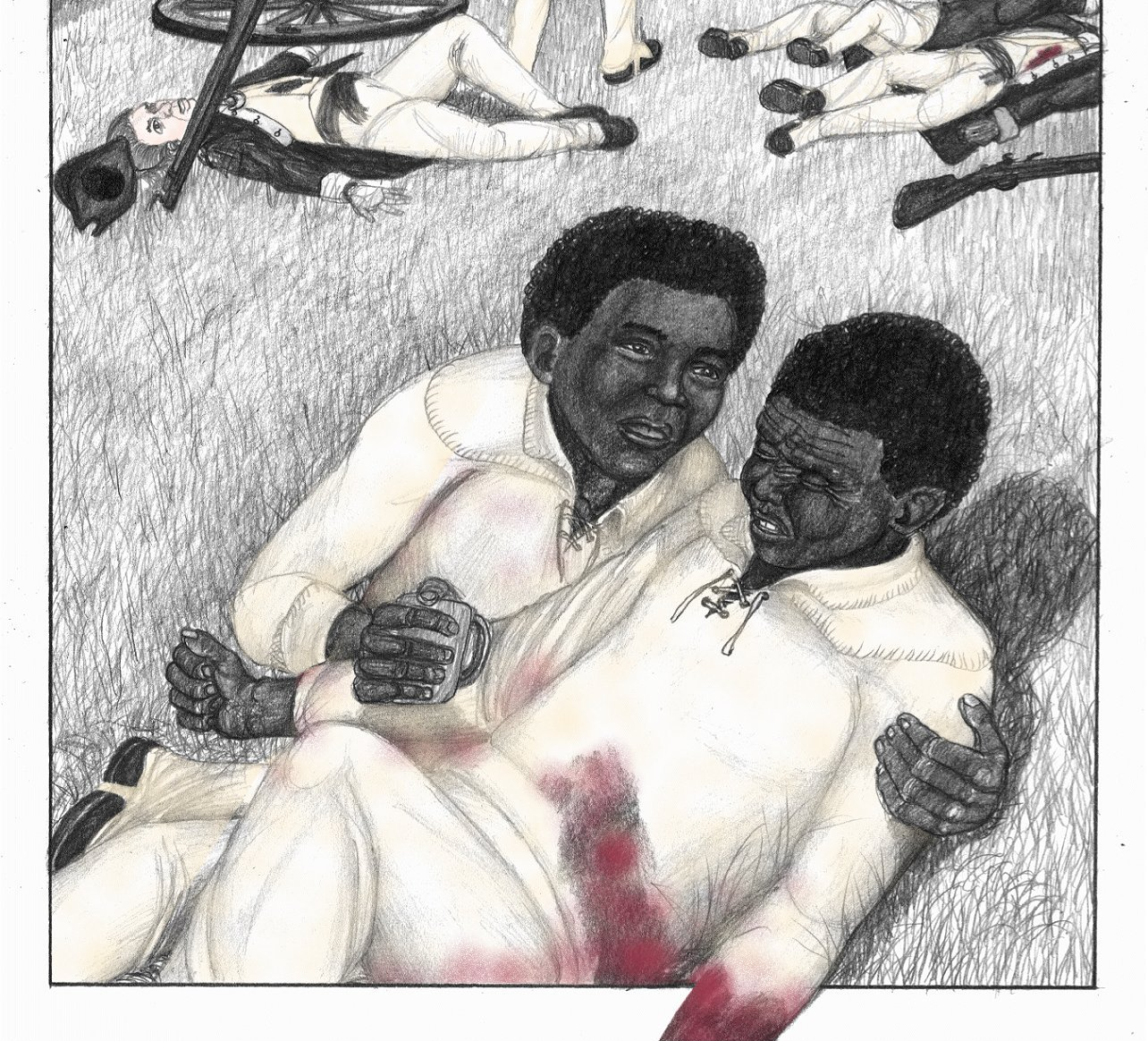
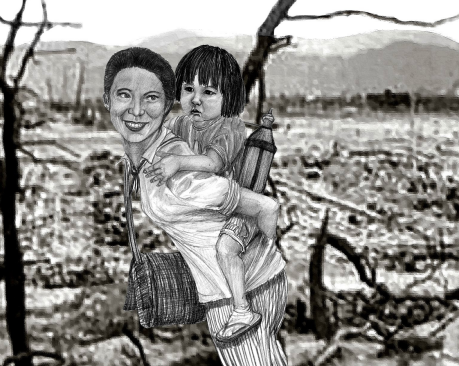
This subject is particularly meaningful for me, in that it reminds me of one of my ‘failures’ as an illustrator. I was hired [not sure I ever got paid] to illustrate a “Hiroshima Diary” but could not finish the illustrations in the time I was given. Most of the illustrations have never been finished, nor published in any form. The diary is the story of a teacher who entered Hiroshima after the bombing, looking for two children who had been sent to Hiroshima for schooling. As she walked the streets of Hiroshima she saw hundreds of children wandering through the rubble, looking for their parents. The only survivors she found were children. Her diary tells of her encounters with wandering, damaged children; all of whom die in her arms…

Ashes of HiroshimaWe did this.

I don’t care how much discussion occurs over the justification of our actions; we obliterated thousands of women and children. Non-combatants. Perhaps they would have become combatants if we invaded Japan. We didn’t, and they weren’t. We slaughtered:

20 U.S., Dutch, British prisoners of war
90,000–166,000 killed in Hiroshima
39,000–80,000 killed in Nagasaki
Total: 129,000–246,000+ killed

 Champions of Truth, Justice, and the American Way.

It must never happen again.


Go back

Your message has been sent

Warning
Warning
Warning
Warning

Warning.


Chronicles in Ordinary Time 74: Life is filled with surprises…

July 11, 2015

p25From the soon-to-be-published, “The Gift of the Magi” by O. Henry

 Jim is a little dismayed…when he left for work this morning, his wife, Della had knee-length hair. At lunch he went out and bought her a pair of elegant hair-combs as a dearly-purchased present. Life is filled with surprises…

My birthday today. 63 is a surprising number. Not that I didn’t expect to reach this number, it’s just that it seems so soon; or so sudden. My brain is still somewhere in my 40’s. The last six years have tumbled all of my plans; and have made it difficult to make new ones…

In 2008 I worked with Medical Teams International in two different parts of the world. First in New Orleans, working on Katrina Recovery; and a few months later in Oaxaca, Mexico. While in New Orleans I watched an exhausted young couple coordinate the efforts of dozens of volunteers, sent out to various places, repairing damaged houses. Earlier in my life, I was a contractor; followed by 14 years in the Bureau of Buildings in Portland. I realized that I could give that couple a break; I knew how to do what they were doing. I just needed to figure out how I’d deal with the finances. I had a belt custom-made when I returned home, as a reminder of my desire to serve… Standing in my room in Oaxaca, overwhelmed with the foreign-ness of the nighttime activity happening on the street below, I realized that I might have found my purpose for the years ahead—using my experience in construction to help others around the world.

Six months later I started seeing neurologists, concerned about two numb areas, one at the bottom of each foot. Six months after that, I lost most of the sensation in my skin, over most of my body. While working with our church in building some homes in a village on the Baja Peninsula, I discovered that working with sharp things wasn’t very smart. I was able to draw blood without feeling it. A similar trip the following year, after the lack of sensation in my skin had covered the rest of my body; I was convinced that I was done with construction. I still have most of my tools; I haven’t found the self-discipline to get rid of them. Now, standing on my feet and walking around for a couple of hours exhausts me. My hands shake when I draw; I have difficulty with finger movement; so now I draw at large scale, and mostly work with digital versions of my drawings. There was a period in my life when I expected to become a ‘famous illustrator’. Life is filled with surprises…

And yet I still find hope… Not hope that the neuropathy will heal; not hope that I won’t have wheels in my future. Nor hope that I’ll still become a famous illustrator. Hope that things will work out OK.

It’s hard to explain hope; I believe that my hope is a gift of the Creator. I have two old guys in my life at present, 10-20 years older than myself. Neither of them has much in the way of hope; both expect to die soon, their dreams for the future unfulfilled. They are both angry. I’d be angry, too. Some days I am angry.

When I asked the Creator into my life in 1973, I determined not to become Religious. I found Religious people to be annoying; they had opinions about my life that had very little basis in fact. I have come to realize that the opinions weren’t far off the mark, because humans are remarkably similar; but they were rude in their presumption. There is nothing in my life that causes me to deserve Heaven, or to have earned a place in Heaven. We don’t spend Eternity with the Creator because we are good people. We spend Eternity in Heaven [whatever that may be] simply because that is what the Creator intended from the beginning of Creation. This idea messes with the minds of a lot of Religious people, and they have all sorts of verses from the Bible that justify their opinions, ‘proving’ me wrong. I learned a long time ago that there is no point in arguing Scripture with these folk. Scripture can justify nearly everything, if one is good at it.
There were two thieves hanging on a cross, next to Jesus. One of the thieves mocked Jesus.
But the other criminal rebuked him. “Don’t you fear God,” he said, “since you are under the same sentence? We are punished justly, for we are getting what our deeds deserve. But this man has done nothing wrong.” Then he said, “Jesus, remember me when you come into your kingdom.” Jesus answered him, “Truly I tell you, today you will be with me in paradise.”

No “Spiritual Laws,” no going to church, no being a good person, no not-doing a list of things that good people aren’t supposed to do. Just, ‘remember me.’ And a promise from the Creator of the Universe, come to earth in the form of Jesus. Most of the people who are most critical of non-Religious people are well-intentioned, although it often doesn’t seem that way. They just never learned to play well with other children…

I see life in America, and life in the Church in an odd way. A dear friend recently described it as a “Specialized Uniqueness.” I have to limit it to America, because I’ve seen very little of the world. I have friends in various places in the world, doing mission-work among people who’ve never really heard of Jesus. The majority of the world has never heard of Jesus, or have heard a very peculiar version of Jesus. To the uninitiated, it seems like missionaries are trying to ‘win points in Heaven’. From my experience, these are people who have found a way to make sense of life, and they truly want to share the experience with others, out of love and compassion. A compassion that isn’t found very often in this world. And yes, it often comes with a ‘yardstick’. To me, that ‘yardstick’ tends to make a lot of sense. But it can’t be forced. Jesus never forced anyone to do anything; and He was fairly intolerant of those who did. Somehow this part tends to get overlooked. He spent most of His time hanging around with the people that the Religious people couldn’t stand. Jesus liked to party.

I’m not big on parties. I don’t like drawing attention to myself [how I ever believed that I could be a ‘famous illustrator’ while not drawing attention to myself I’m not sure I’ll ever understand]. Maybe when I get Home I’ll enjoy parties…

 the universe in his hands_1


Go back

Your message has been sent

Warning
Warning
Warning
Warning

Warning.

Chronicles in Ordinary Time 73: Altruism

June 14, 2015

robot 2

I watched Guardians of the Galaxy this afternoon; amusing, but I’m getting tired of ‘comic book’ movies, aka ‘collateral damage’ movies. Movies whose most prominent feature is the property damage that occurs during the battles between the good guys and the bad guys. The movies rarely, if ever, deal with the fact that lots of people lose most of their stuff, if not their lives; and that the heroes of the movie rarely help the victims recover. That’s one of the places where the difference between life and movies becomes obvious.

C.S. Lewis hoped that mankind would never venture into the solar system and beyond—his fear was that we would spread the infection of our foul natures out to the other life in the universe. Ever notice how the science fiction movies that get made so often assume that other intelligent life chooses evil as a way to live? I can’t help but wonder whether or not other life in the universe may never choose evil as a way to respond to life…

I have a friend who is angry at god because of the evil in the world. I keep telling him that most of the evil in the world comes from the hands of man; and our tendency to use our Free Will to take advantage of others. We want what’s best for ourselves and are unwilling to put ourselves out for the benefit of others. Not all of us, not all of the time; but all it takes is a few of us taking advantage of others to ruin it for the rest of the world. Too many people respond to the bad stuff that happens to them by passing that bad stuff on to others. We feel crappy, or we feel crappy about our circumstances, and we act crappy toward others. The disease gets passed on to others.

Can you imagine a world where people treat each other, treat everyone graciously? I can, sort of, because I’ve met these kind of people. Not a lot of them; and most of them wouldn’t want to consider themselves as being ‘especially good’ people—we all know our failings, and these folks would look first at their failings, and consider them more significant than the good stuff that comes so easily to them. People that decide to live an entirely different life than most of us choose. I know a young couple, with a new baby, who have chosen to live in ‘outer Mongolia’ in order to tell people about Jesus, in a world where nearly everyone has never heard of Jesus. They have a different religious belief. To those who believe that one religious belief is as bad as another, this concept has a negative tone. It used to have a negative tone for me. Life changes one. I know this couple who are giving up most of the stuff that the rest of us strive for—there isn’t anything negative there. The same belief that sends healthcare workers to fight Ebola and MERS in a different country; the same altruism that sends people to Nepal when people are fleeing earthquakes. The altruism that sends First Responders into burning buildings…

It isn’t me; my goals are more mundane and more career-related. I’ve looked at this concept for lots of years.

I like to close with another illustration; none of the people I’m thinking of would like their faces to be used—they wouldn’t want to be seen as an example. So, I’ll end with some who are anonymous, and can express joy:

silhouette tap


Go back

Your message has been sent

Warning
Warning
Warning
Warning

Warning.


Chronicles in Ordinary Time 72: The Hard Questions

May 22, 2015

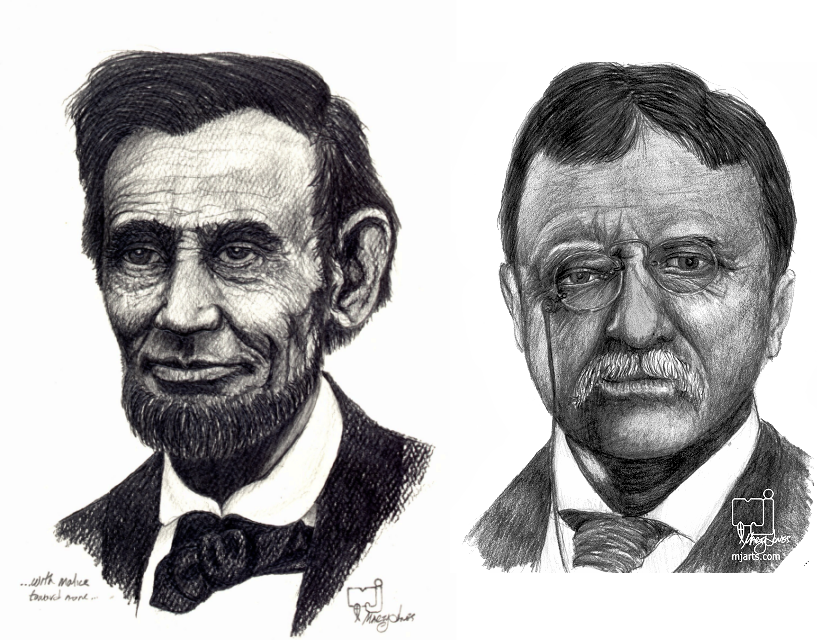
Black Care

Abraham Lincoln battled it before and while he was President. A lot of the world’s great artists battled it all the time; and sometimes battled to the death.

Theodore Roosevelt called it “Black Care”—I wrote about it before:

https://mjarts.wordpress.com/2014/03/14/chronicles-in-ordinary-time-47-black-care/

Today we call it Clinical Depression, Bi-Polar Disorder, Manic-Depression—they aren’t all the same, but they have some similarities. They all lurk in my gene pool [which hasn’t been filtered well enough]. Dealing with Black Care can be awful.

Thanks to the wonder of modern chemistry, I may have passed through another valley. It seems too soon for the increased dosage of Prozac to have worked, but there’s some sunlight in my life today; couldn’t say that yesterday. I still ache all day, I get shooting pains in a variety of places all day long, my feet feel sunburned all the time. My teeth are clenched—I realized I have a habit of pushing on my upper palate with my tongue—it keeps me from grinding my teeth…

Sometimes I get asked how I write these Chronicles [or, I receive spam that looks like someone is asking a question]. Usually they percolate in my brain for a period of time [ruminate might be a better word]; and I get the urge to put the words on digital paper. Frequently the hard part is finding the illustration. I generally don’t draw people in a snarky mood. Too close to home.

People who are very important to me are dealing with a lot of shit right now; and there’s absolutely nothing I can do about it besides praying for them, and asking some ‘prayer warriors’ I know to pray as well. Prayer isn’t magic. The Creator is not our magic butler who makes everything work out for us. A lot of the time, I think that when all of the Gears of Life [think of the Lionsgate Movies logo] are turning in such a way that the Creator’s plans work out to our advantage, we sometimes see unexpected, but hoped-for things happen in our lives…Being human, we only consider answered prayer to be “yes”—sometimes the answer is “wait” and we don’t like that answer. We like “no” even less; but by definition, “no” is an answer.

The pain of those close to me is my own pain. This is part of the reason I allow so few people to get close to me. My daughter’s tears at 35-ish set off the same internal alarms that they did when she was 5. Reading about my son’s tears sets off the same alarms. And I don’t want to not hear those tears. Part of the weirdness of being a parent.

I’m currently wading through Augustine; CS Lewis recommended that we should always read from older periods in history, so that we can better understand the present. I haven’t followed that advice too strongly; but my first introduction into ‘theology’ was reading Marcus Aurelius in college. He asked the same questions I was asking. Job, the oldest book in Torah/the Old Testament, something like 4000 years old, asks the same questions.

“How can there be a loving God when this is such an awful place to live?”

“How can a loving God allow all of the hatred and war in the world?”

“How can there be a loving God who allows typhoons and earthquakes to devastate populations?”

“How can there be a loving God who allowed the Holocaust, and who allows the brutality of ISIS and Boko Haram?”

My short answer to these questions is that we have a Creator who has endowed us with Free Will and so values our individuality and respects our right to express ourselves that He allows us to commit all of the stupidity we find necessary to live; in hopes that some day, as individuals, we will come to our senses, and ask the Creator “how should we live?”

Just because people commit crime and blame it on God does not mean that God had anything to do with the crime…God gets blamed for an incredible amount of human misery.

“Torah tells how God caused the Israelites to wipe out nations; God wiped out mankind in the Flood and God sent plagues to the Egyptians. How could a loving God do that?”

I believe that Torah and the New Testament are True, and Inspired by the Creator. I also believe that these books are more like what we term “a journal” than complete histories of those times. These are the journals of the Hebrew people and the early Church. Statements and explanations of what happened; they don’t necessarily explain what the Creator wanted to have happen. I sometimes wonder if the things attributed to the Creator really were the Creator’s wishes…The things happened—David murdered Bathsheba’s husband so that he could get into her pants—it was not the Creator’s will. We are granted an incredible amount of choice, and sometimes we choose to blame God for our own greed and selfishness.

How could God have destroyed innocent men, women and children?

I have no idea what the destroyed nations were like; perhaps these nations were committed to paths of destruction. Human sacrifice [often sacrifice of children] was a very common way to ‘appease the gods’ in ancient times. Animal sacrifice goes on today. For a moment, suppose those nations were like ISIS and Boko Haram? Would our question have a different answer?

Who will the young boys living under ISIS grow up to be? Will they emulate their fathers and uncles? Would it be more merciful if they didn’t grow up at all? This isn’t a question I have been given to answer.

As 21st Century American individuals, we have no real understanding of what it would be like to live under an all-powerful and benevolent Ruler who commands obedience for our own welfare. It’s never happened in recorded history. Even writing the words, “commands obedience” causes warning lights to flash in my head. Growing up with my Dad. The Creator isn’t like my Dad. My Dad, was in some ways, like the Creator.

When the Israelites asked God to give them a king, so they could be like other nations, God’s response was a warning that they really won’t like what happens if they have an earthly King; and yet God gave Israel a King. The Kings of Israel were just as flawed and stupid as the rest of humanity.

We live on a rock floating in space, rotating at 24,000 mph, and traveling around our Sun for a year per revolution. Our distance from the Sun changes over the course of the year; our planet’s tilt, relative to the Sun, and that changing distance cause extreme changes in temperature during that year. At the center of this rock is a molten core of incredibly hot liquid. The surface of our world is a series of rock-plates that float on this molten core—extremely simplified geology. I live on the side of a volcano that is situated in a region that will most likely have a devastating earthquake in the coming decades. I haven’t moved to Iowa; nor to Maui, which would be my preference. There is only so much potential for destruction that my imagination will allow me to deal with.

Given all that we have learned about the non-static nature of the earth, why would we expect it to be static and always nice?

“Because God created the world and called it good.”

The Hebrew word translated as “good” is defined as, “to be (transitively, do or make) good (or well) in the widest sense.” To expect that ‘good’ means ‘perfect’ is projection of what we’d like it to mean. I think ‘good’ probably means something more like ‘sufficient’ than like ‘exceptional.’

I have three of the most terrific adult children that a parent could ask for. They are all flawed, in different ways than I am flawed; they all have traveled paths I wish they wouldn’t have traveled; and yet I have always tried to support their endeavors to the best of my ability at that time.

My children don’t experience the relationship with their Creator that I experience. I have no idea why, because I never asked for my experience…which isn’t entirely true, because I did ask for this experience; I just didn’t know what I was asking for. I knew that I didn’t know enough about life to live it successfully; three years in college had already made that clear to me. I had no spiritual background or experience, growing up. Asking the Creator of Life to lead me seemed to be a really smart choice when I finally understood the question; I really couldn’t understand why my parents weren’t as enthusiastic about this new awareness as I was. I found they had run from the Church; they never talked about the particulars.

The older I get, and the more I see of life, the more I wonder how my children view me. Someone with some odd beliefs about how Life works; perhaps someone who isn’t as enlightened as they are…

I have been blessed with encounters with the Living Creator for the last 40-odd years [or 40 odd years]. I long ago realized that mine is not a universal experience; and when it is experienced, it often is expressed in a manner that I find very peculiar. Probably as peculiar as my children view me; and as peculiar as I viewed ‘religion’ in my first years of college. I admire a gal at our church who says that she doesn’t have a ‘sarcasm’ gene. I can’t relate, but I admire the concept.

I am bothered that as a parent, I didn’t demonstrate the nature of “belief in the Creator” in such a way that my children would want to emulate that belief. Scripture teaches that my belief is a gift of the Creator. Sometimes I feel like it was a gift given to the wrong person. I can’t see my life as my Creator sees my life. That happens when I get Home.

I believe we are created with Eternal Souls; that Earth is a place where we are intended to learn how to live well with our fellow creatures. I believe there is another ‘plane of existence’ that isn’t tied to bodies and disease and suffering; and that we arrive at that plane when we leave these damaged bodies behind. I also believe that we could do a much better job of living with each other than we do. It’s our greed, our stupidity, our selfishness that makes this world a garbage heap…

We can each become the change we want to see in the world. That’s frequently a statement that is much easier to write than it is to do. I wouldn’t have written this statement in recent days. I thank God for Prozac. Those who manage to get through this life without the aid of chemistry are truly blessed.

piggy back draft 5From “A Dimly Burning Wick” a Hiroshima Diary


Go back

Your message has been sent

Warning
Warning
Warning
Warning

Warning.

Chronicles in Ordinary Time 71: Missing the Point

May 3, 2015

DragonFire1Dragon Fire [digital painting]

I did a ‘Hobbit Marathon’ last weekend; the third installment arrived from the library. I decided to revisit the earlier installments to get back up to speed. After watching 6 or so hours of Hobbit, it occurred to me that between the Hobbit trilogy and the Lord of the Rings series of movies, it was very easy to miss the point of the whole story—the destruction of a Ring of Great Power because it was too dangerous to be left in human [or otherwise] hands. Amidst the Hobbits, the Orcs, the Elves, the Dwarves and Trolls; amidst the Wizards and Fell Creatures, it’s easy lose sight of the main character—the One Ring.

We humans are great at missing the point.

People argue over the idea of Bible Stories being true. They bring up the quandary of whether a whale could swallow a man for three days, and miss the point of the story. The whale is actually a very minor character in the story of Jonah. The point of the story is that the Creator wants the people of Nineveh to change their way of life to that of “love justice, show mercy and walk humbly with their God.” Jonah apparently has a real problem with the Ninevites and wants God to blow them off the face of the earth; rather than asking them to change. The people change for the better, and God wins.

We tell Bible Stories to children because most of the concepts in the Bible are adult concepts that can’t be understood by children. We tell them the stories with animals and kids and Jesus’ miracles because these ideas can be understood by children. Sadly, many of those children become adults without every hearing or reading the rest of the Bible, and they never wrestle with the adult difficulties of “love justice, show mercy and walk humbly with your God.” They write off the stories they heard when they were children, because those stories don’t seem to apply with the real difficulties of life; and they write off the Bible.

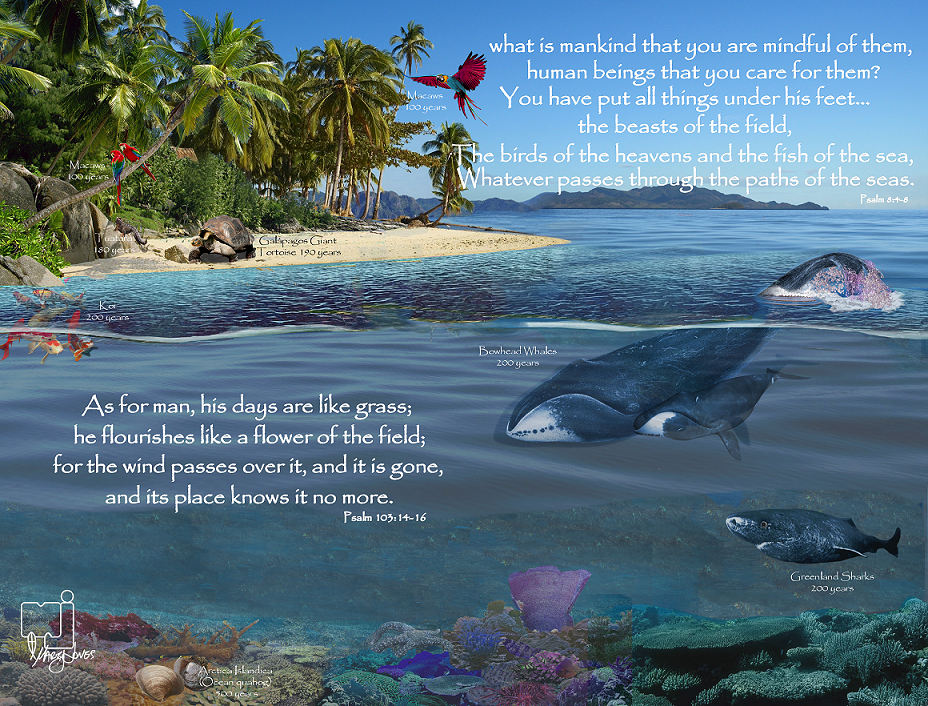
I read an article online recently, one that talked about the 10 longest-living creatures on the planet. Humans aren’t on that list.

what is man_webWhat if we are missing the point again?

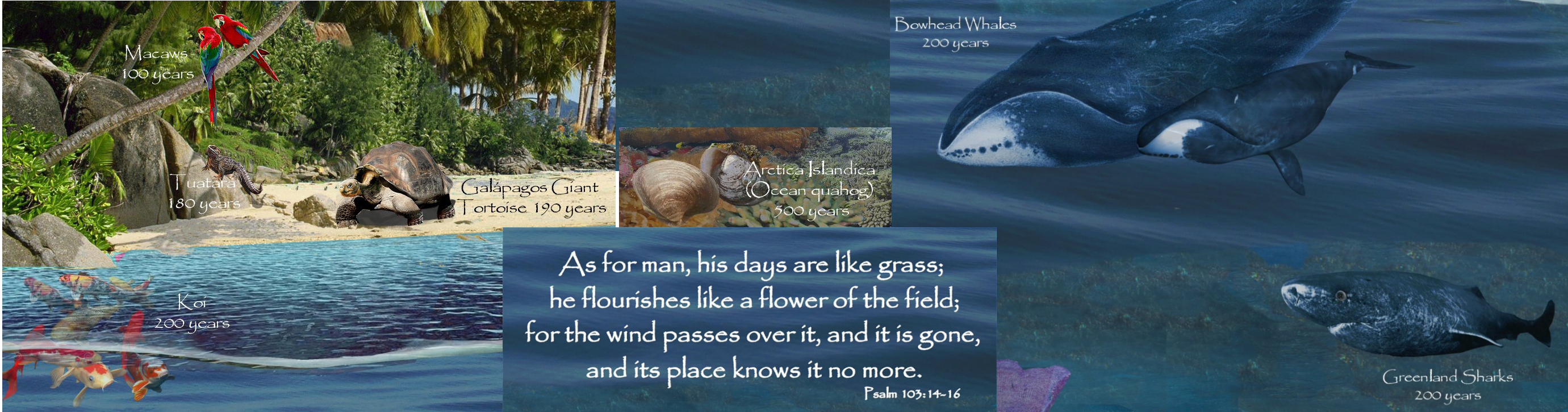
The Bible talks about the great ages of the people before the Flood; and people ponder how those incredible lifespans could be…the age of an Arctica Islandia; an Ocean Quahog clam [500 years].

what is man_his days are like grassWhat if the point of all those great lifespans were simply to allow us to take care of Creation? To have a Galapagos Tortoise or a family of Macaws as friends, and to watch their life cycle?

Genesis 1:26 reads: Then God said, “Let us make mankind in Our image, in Our likeness, so that they may rule over the fish in the sea and the birds in the sky, over the livestock and all the wild animals, and over all the creatures that move along the ground.”

The Hebrew phrase: בְּצַלְמֵ֖נוּ כִּדְמוּתֵ֑נוּ וְיִרְדּוּ֩ בִדְגַ֨ת הַיָּ֜ם  can be translated: “in Our image, according to Our likeness; and let them rule over the fish…”

The word וְיִרְדּוּ֩ means to ‘rule’/’have dominion’ and is a verb; consequently the word means an action rather than a position. We are to act in the manner of one who rules over Creation; not one who tells Creation what to do, but one who nurtures Creation.

As the story continues, man, having failed to do his job correctly, gets wiped out; and God starts over again with one human family, and all of the other families of Creation. From one perspective, Man’s assignment is still the same. Take care of God’s Creation. And God promises that the world will never again be wiped out by a Flood.

This time we are doing it ourselves.

We missed the point again.


Go back

Your message has been sent

Warning
Warning
Warning
Warning

Warning.


Chronicles in Ordinary Time 70: The Battle of Bedford Falls

April 29, 2015

klara_holdenfrom The Book Lover

   The title of this entry is from a movie reference, Frank Capra’s It’s a Wonderful Life. George Bailey of Bedford Falls opts to take the role of Rescuer instead of the role of Adventurer; and the decision changes the course of his life. He takes on a job he doesn’t want, in order to rescue his family; he marries, ends up living in a drafty old house, takes on the role of father and ends up taking the fall for a mistake supposedly made by a daffy old uncle. On the verge of bankruptcy, he attempts suicide; and is rescued by an unlikely [and non-Biblical] angel. Clarence the angel gives George the gift of seeing what his world of Bedford Falls would have been like had he never been born…

The Battle of Bedford Falls is the battle of making it through another day when everything inside of you wants to opt out of the experience. There are a lot of other options to suicide that accomplish a similar task—‘opting not to play the game’ one more day; and immersing oneself in a variety of activities that postpone the inevitable.

When I started writing for public consumption—this venture into online journaling—I decided that I would only write about things I know about; things in which I have some expertise. I don’t write to gain “followers”—although they are appreciated; and I don’t write to ‘monetize’ my thoughts. I write as a way of exploring my life and myself, and hopefully express in words some thoughts that others may not be able to find the words for. Occasionally using bad grammar…

My only areas of expertise are subjects related to the Building Code; and a very particular style of illustration. These aspects of my life don’t offer a lot of practical wisdom [I wish I’d had more of the former, when I was building the house I’m in]. I’ve built houses, written City policy, raised kids into adulthood and stayed married for nearly 39 years. I’ve rarely left Portland; and at the same time have traveled to the Gulf Coast and to Mexico a few times for construction-related mission work.

I have years of training in how one can change their life for the better, and I’m happier with ‘me’ than I was 30+ years ago; but I only know how to change me—I can’t change other people. The most that I can do is create an environment where people can change, if they desire change. I can offer suggestions [many of which are for me, facts]—but until someone accepts my ideas as their own, they are simply ‘suggestions’. I can provide people with a list of books to study, but I can’t make them read the books or try to implement them into their lives.

There’s rioting in Baltimore; perhaps not tonight, but there has been rioting over the last few days. Rioting in lots of cities, reminding me of the late 60’s—the rioting then had different causes. Throughout the Twentieth Century and overflowing into the Twenty-first, we have become a people who prefer antagonism to mediation. Despite a century of bloodshed, people still pick up weapons in order to feel safe. The proliferation of weapons isn’t making us any safer.

The Battle of Bedford Falls—how do we get through today?

I feel shitty most days, at the start of my day; I start the day, these days, feeling like I did at the end of the day in the past. Due to my neurological issues, my entire body feels wrong; my legs, from the knees down feel wrong, but I’ve been walking for something like 60 years; my muscles know how to walk. I choose to ignore how I feel and walk anyway. The reality is that I know of dozens of people who are in worse shape than I am. So I start my day in prayer, listening to music that turns my mind toward the Creator and my inner self. I ‘lift people up’ in my prayers—I’m not smart enough to tell the Creator what His creation needs. Praying for others takes my mind off of myself. Do my prayers change the world? I have no idea. They change me, over time. Among those changes are a growing list of people—I pray for people I don’t know, I pray for people I’d rather not talk with.

I make sense out of my life by the belief that this life is but an eyeblink in the span of Eternity. I was told long ago, that we are minds with a body, rather than the reverse. Over time I have come to believe that we are Eternal souls that have a mind and a body. That Earth is a place where we are intended to learn how to live well with our fellow creatures. I believe there is another ‘plane of existence’ that isn’t tied to bodies and disease and suffering; and that we arrive at that plane when we leave these damaged bodies behind. I also believe that we could do a much better job of living with each other than we do. It’s our greed, our stupidity, our selfishness that makes this world a garbage heap…We blame God for not stopping us from doing the things we can do by our own choice.

And this is a lousy way to end this entry…probably indicative of my mood—I’ve been repairing a washing machine over the last couple of days, and I dislike the toll it’s taken on my body and mind. It used to be a lot easier.

In spite of a lot of evidence to the contrary, I look forward to seeing what another few years will bring into my life. I’ve met people I would not have met before; there are people I care about now that I didn’t know a couple of years ago. Granted, I’m not seeing a lot of points on the ‘win’ side of the ledger these days, but I lack the ability to see into the future. I have to wait for the future to show up. I see my kids overcoming huge obstacles, and I believe they will continue to move forward. Every day I see indicators of positive change for the future of mankind—if we will stop fighting each other long enough to pay attention. We walk in the shadows of giants; and I believe we will see more giants in the future, if we will simply pay attention.

Go back

Your message has been sent

Warning
Warning
Warning
Warning

Warning.

Chronicles in Ordinary Time 68: We Aren’t What We Think We Are

March 31, 2015

Imagine a baseball stadium…

stadiumI’m not really a science guy, but I’m fascinated with science; I find that my generic understanding of science helps me to understand the Universe, which means that science helps me understand the nature of the Creator.

As I understand it, if an atom was the size of a baseball stadium, the nucleus would be the size of a baseball, and the electrons of a water molecule would orbit somewhere within the confines of the stadium structure. Quantum mechanics, and that concept which is sometimes, but not necessarily accurately called ‘Heisenberg’s Uncertainty Principle’, proposes that the act of looking for a particle actually changes the location of the particle—so I’ve indicated the Hydrogen atoms as amorphous ‘star’ like images. When you look to find them, they will most likely be somewhere else…

The rest of the volume of the stadium is empty. Electromagnetic forces and nothing solid. We are made up of zillions of atoms; consequently, we are made up of zillions of packets of empty space and a ‘few’ atoms. And yet, we believe ourselves to be made up of solid material. The apparent solidity is caused by the electromagnetic forces within the atoms.

We aren’t what we think we are.

So, what are we?

A question that has been asked for Millennia. One of the aspects of living in this cyber-era is that we have a tendency to believe we know so much more than our human counterparts of the last centuries. There are a lot of ‘factoids’ that we now know that people in the past did not know; but that doesn’t always mean we are all that much wiser…

I believe that we are eternal souls attached to bodies. Each of these bodies start with two cells, which when combined, divide and subdivide, and replicate each other; in the process creating a chain of DNA that provide all of the instructions for making an adult human being over a dozen or so years; with a certain hair coloring, a specific eye color, a particular skin color—all of the externals that give us identities. The little whorls on your fingers that are totally unique to you [at least as far as anyone has been able to determine]; the shape of the folds of the ear, which may also be unique to you. A zillion atoms, each with a unique DNA structure that can identify YOU even after death.

And the soul? People have been looking for the soul for centuries. People have tried to weigh the human body at death to see if one’s weight lessens as the soul leaves the body.

Perhaps the soul is found in all of those packets of ‘empty’ space within our atoms…

People tend to get very anthropomorphic about the nature of God—they believe that God has to look something like us, or some other created being. Torah [the Book of Genesis] states that we are made in the image of our Creator. If God was human, it would be reasonable to expect that our bodies are made in the image of the Creator. We make images based on our imaginings; these created images symbolize a larger idea.

Creatio_of_AdamDid Michelangelo really believe that the Creator was an old man with a beard, supported by a number of other beings? No. However, at this time in our history, painting the Creator as something more like E.T. wouldn’t have made sense to people. Michelangelo loved the human body, and felt that the human body could be the epitome of creation. I never took any Art History classes in college; and I don’t think in the same manner as other people think. Symbolism sort of escapes my attention unless it’s incredibly obvious. I’m not sure what attributes of the Creator Michelangelo intended to portray by portraying him as a guy with a beard. From reading The Agony and the Ecstasy, a biographical novel about the life of Michelangelo, the Pope who commissioned the painting of the Sistine Chapel was surprised by Michelangelo’s portrayal of the Creator; he expected someone more harsh and demanding.

I believe the Creator is far closer to pure energy than to human beings; that ‘created in His image’ refers to our ability to create, to imagine, to bring our imaginings into fruition. Not being of the Energy that created the Universe, we have to create using tangible or visible materials; and our creative efforts require sweat, work, and the determination to overcome obstacles. Or not.

We are never required to create; we can go through an entire lifetime never having created anything. I think I’ve met people like that—a lifetime of following instructions for the assembling of ‘pieces’ that someone else created. A lifetime on ‘the assembly line’—is this wrong? Probably not. However, I don’t believe this fulfills our potential as images of the Creator.

When I create the images I use in these mental meanderings, I’m not actually creating anything beyond an idea. Photons of light are absorbed by the retinas of your eyes; and electrical impulses travel up your Optic Nerve into your brain. Somehow [no one really knows how], these impulses get translated into a visual image.

This is the interior of your brain…

grady's brain

Microscopic webs of tissue that connect and reconnect and somehow incorporate to form an image. That bright web is a portion of a thought. Note: there are no flat screen TVs in your brain. You [ideally] have two small holes in the front of your head; they are similar in nature to the shutter in a camera. Light contacts cells in the retina—the back of your eye—and those cells send electro-chemical signals into this mass of tissue [it’s really grey] located on the top of your spinal cord. Folded layers of cells sort of like a sponge [the ocean kind of sponge]; somehow those cells present the world in your brain, as if you are looking at a flat-screen television. When I think of him, I have a ‘video’ in my brain of my Grandfather slowly dancing around the dining area of our family cabin; listening to Norwegian folk tunes on the record player. No one ever filmed this image; and yet I have a portion of the video in my ‘little grey cells’ [Inspector Poirot].

For those that are blind, a ‘picture’ of the world still forms; the image is probably more like looking at an infrared image, in black and white: objects in relationship to other objects—maybe something like a map. Some of those objects are connected to sounds; some objects are connected to smells. Texture becomes important in ways that we sighted people tend to ignore. Most of my sensory nerves are damaged; texture, taste, aroma are somewhat meaningless terms to me—my own form of ‘blindness’. Thankfully, my eyes still work, even though they don’t work like they used to.

We aren’t what we think we are.

We aren’t yet what we can become.


Go back

Your message has been sent

Warning
Warning
Warning
Warning

Warning.

Chronicles in Ordinary Time: Non-sequitur

March 14, 2015

Dr.WatsonWhy does one blog… I write as a somewhat therapeutic aid to living with a broken body in a broken world. Therapists frequently suggest ‘journaling’ as a way to deal with one’s inner world. I did that years ago; and the journals are all buried; hopefully no one will ever read them.

This form of journaling is different, in that I hope it will be read by someone dealing with the same sort of crap that I deal with. Or someone who is amazed as I at some aspect of Life.

As a blogger, WordPress filters a whole lot of “Feedback” that apparently arrive to my address. Four-digits every time I check; no matter how often I visit my ‘dashboard’. Tomorrow there will be 4-digits, even though I just deleted 4-digits. Normally, I see huge volumes of spam in the “Feedback,” which I’ve come to expect. Every time one posts something on the internet, the Universe seems determined to respond with garbage.

Today was different. I found stuff in my “Spam” folder that may not be spam. My mental picture is that there is some soul who is sending out marketing spam because that’s their job; and in the midst of doing their work, they happen across my blog. I don’t know if that mental picture is accurate. One gets accustomed to phrases repeated over and again–this stuff I realize is somewhat-more-creative spam…

For those who have written appreciative comments in the past, from the computer of some spam-producing company, I apologize for not sifting through the spam. I don’t have the energy to sift through 4000 comments, looking for real ones. I appreciate the real comments that get sent; whichever ones those might be.

I’ve been trying to understand life for something like 6 decades; I’m not done yet. Hopefully I can be of some assistance to another soul.

Blessings, Marty

Mikey avatar 3


Go back

Your message has been sent

Warning
Warning
Warning
Warning

Warning.