Editorial Comment I don’t usually let this guy out in the world The sorcerer’s apprentice is now the sorcerer Something amazing is happening on Sunday [8/30/2026]
The Roman Telescope Promises a New Era of Cosmic Exploration NASA’s latest offering to the stars comes from a legacy of great observatories that enabled decades of discovery and unearthed new mysteries about the universe
NASA began experimenting with orbiting astronomical observatories alongside its Apollo program in the 1960s, and by the end of the next decade, Congress had approved funding for what would become known as the Hubble Space Telescope. That was in large part due to efforts by Nancy Grace Roman, NASA’s first chief astronomer, who played a pivotal role in building out the agency’s space astronomy program.
Nahmanides and the Big Bang The Big Bang theory is believed to have been first proposed in the 20th century, but was actually proposed much earlier by biblical scholars, taken from information in the Old Testament. The earliest existing reference is in a commentary on the book of Genesis written by Nahmanides (1194-1270) Of course, Nahmanides never referred to it as the ‘big bang’, but this is basically how he described the first moments of the universe. Here it is in Schroeder’s own words: From Gerald Schroeder: Genesis and the Big Bang “In the thirteenth century, Nahmanides quoted a commentary on Genesis written 600 years before him, noting that prior to the existence of the universe, time did not exist. This was learned from the wording of Genesis 1:5, “. . . and there was evening and there was morning, day one.” It is not stated “the first day.” For the use of first would have implied an already existing series of days or a continuum of time when in fact on this “day one” there had been no prior time to this one day. Not a before and not an after. There was nothing to which one could relate this day. It stood alone as “day one.” For all the remaining days in that week of Genesis, the ordinal terms, second, third, etc., are used and. logically so. By day number two, and thereafter, a series of days had been established. Although it is difficult to comprehend, the creation of the physical universe brought with it a concurrent creation of time… Nahmanides’s account of the first seconds of the universe reads like this: At the briefest instant following creation, all the matter of the universe was concentrated in a very small place, no larger than a grain of mustard. The matter at this time was so thin, so intangible, that it did not have real substance. It did have, however, a potential to gain substance and form and to become tangible matter. From the initial concentration of this intangible substance in its minute location, the substance expanded, expanding the universe as it did so. As the expansion progressed, a change in the substance occurred. This initially thin noncorporeal substance took on the tangible aspects of matter as we know it. From this initial act of creation, from this ethereally thin pseudosubstance, everything that has existed, or will ever exist, was, is, and will be formed. Back to Schroeder: “Nahmanides’s reference to a grain of mustard is the traditional way of saying, “in the language of man,” the tiniest imaginable speck of space. Nahmanides taught that at the beginning, all that is on and within the Earth and all the heavens, in fact all the universe, was somehow packed, compressed, squeezed into this speck of space, the size of a mustard grain.”…
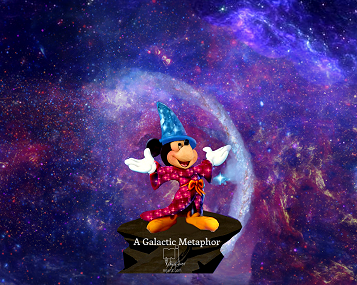
The sorcerer is a metaphor for how the Universe began. I happen to be the guy who opened a door…
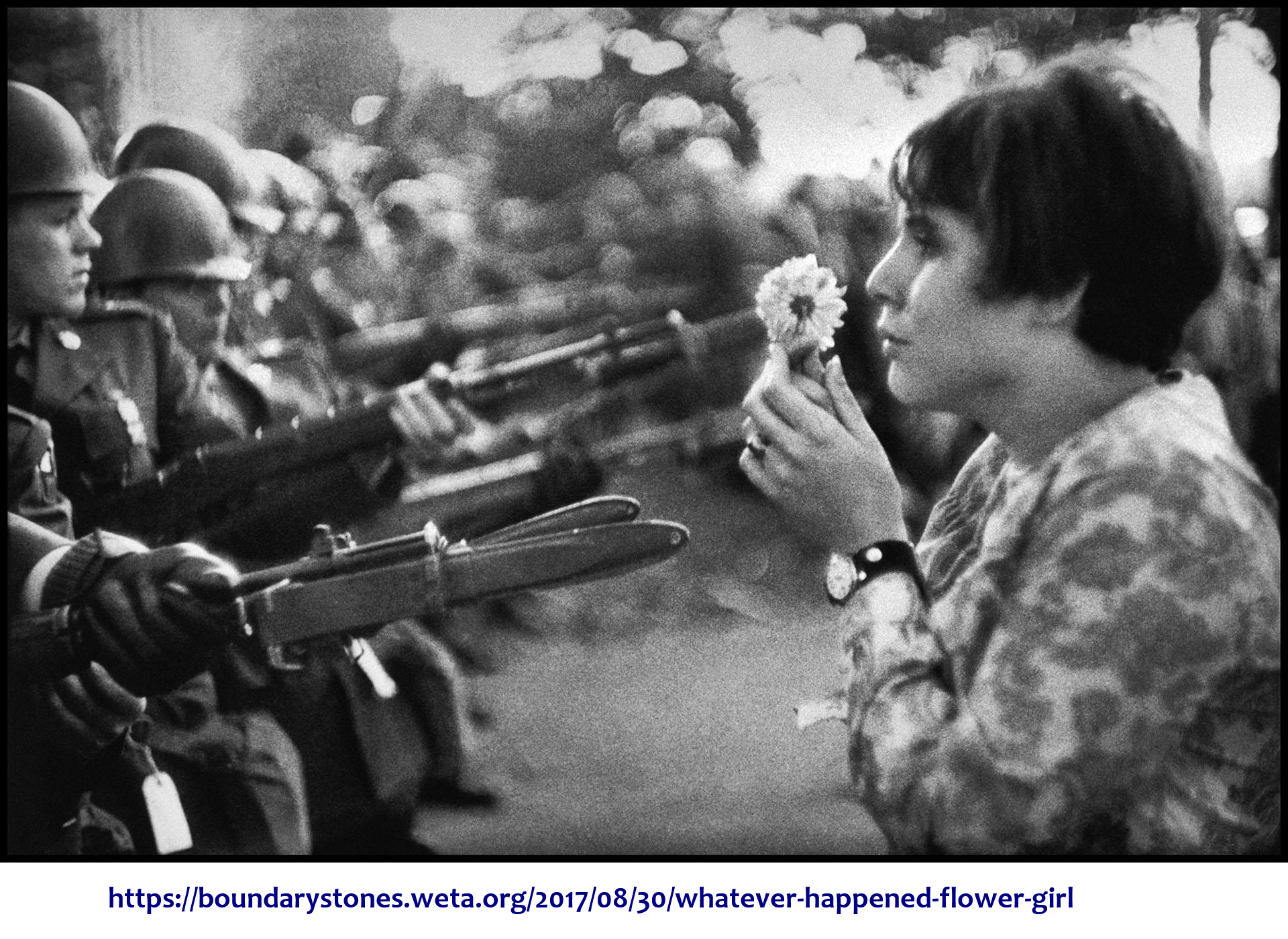
https://boundarystones.weta.org/2017/08/30/whatever-happened-flower-girl Marc Riboud was one of the journalists there to cover the event. He first noticed 17-year-old Jan Rose Kasmir standing directly in front of a group of soldiers, all of them holding rifles at the ready with bayonets attached. “She was just talking, trying to catch the eye of the soldiers, maybe try to have a dialogue with them,” Riboud recalled years later. “I had the feeling the soldiers were more afraid of her than she was of the bayonets.”[1] Riboud quietly snapped away in the fading daylight as Kasmir tried to draw the attention of the soldiers, many of whom were not much older than her. They did not engage her, instead remaining stoic and visibly unmoved. Kasmir later said, “At that moment, the whole rhetoric melted away. These were just young men. They could have been my date. They could have been my brother. And they were also victims of this whole thing. They weren’t the war machine.”[2] Kasmir had no idea just how famous she had become for almost 20 years. Riboud did not introduce himself to her after taking her picture, and she went on with her life. “I had no idea somebody had taken my photograph that day,” Kasmir said. “I stayed at the protest until it got dark, and then took the bus home. To me, it was not a particularly eventful day.”[4] Riboud and Kasmir were reunited in 2004, in London where Kasmir took part in a demonstration to protest the Iraq War.
What happened to us? The Sound of Silence Paul Simon …in the naked light, I saw Ten thousand people, maybe more People talking without speaking People hearing without listening People writing songs that voices never shared And no one dared Disturb the sound of silence
“Fools” said I, “You do not know Silence like a cancer grows Hear my words that I might teach you Take my arms that I might reach you” But my words, like silent raindrops fell And echoed in the wells of silence
And the people bowed and prayed To the neon god they made And the sign flashed out its warning In the words that it was forming Then the sign said,
“The words of the prophets are written on the subway walls In tenement halls” And whispered in the sound of silence
America’s Children [who now are adults/senior citizens] Stephen A Stills
And you got to be brave children How many is it that they shot down already? Something like seventeen of us. But you know we gotta do it We gotta keep on keeping on Because if we don’t do it nobody else is gonna But you know if we can’t do it with a smile on our face You know if we can’t love in our hearts then children we ain’t got no right to do it at all Because it just means we ain’t learned nothing yet We’re supposed to be some kind of different And I don’t know if I want white America to remember or to forget That Jesus Christ was the first non-violent revolutionary
I recently added to my spotify collections, the music I listened to during my first two years of college. Cat Stevens, Paul Simon and Crosby, Stills and Nash and others. I was listening to “4 Way Street” when I once again heard Stephen A Stills’ “America’s Children”—and I realized one of the reasons why I’ve been frustrated in this century—I believed we could really change society. I lived down the hall from Ron Wyden, a grad student; I was a junior. We rarely spoke. I will be 72 in a too-short time.
My parents’ ‘religion’ [my term, not theirs] was a combination of the American Legion and the Lion’s Club. At the church service upon her death, I was greeted by Legion people, Lion’s people and church people. She never wanted to hear about church, so it was very strange to find her going to church each Sunday, with people from her condominium. I think she went for the sake of belonging. I [think] I rarely had babysitters and went with my parents to the Legion Hall. I was ‘the boy who slept on steel chairs’ as I grew, another chair would get added. I slept on the table behind the bingo caller; I slept through a Drum and Bugle Corps in a space about the size of the gymnasium in my elementary school. I grew up with God and Country Republicans. They were good people. They would be appalled, today.
Oregon Governor Tom McCall had a brilliant idea when the American Legion Convention was coming to Portland. He created a smaller version of Woodstock: “During the war-hot summer of 1970, thousands of young people began streaming toward Clackamas County’s Milo McIver State Park to attend Vortex I, a state-sponsored rock-music festival. Ed Westerdahl, chief of staff to Governor Tom McCall, had selected the 847-acre site, some thirty miles southeast of Portland. The park provided all the advantages that Westerdahl sought—a rural setting, proximity to Portland, and easy driving distance from Interstate 5. The festival was strategically planned to attract young anti-Vietnam war protestors who otherwise might descend on Portland to disrupt the American Legion’s annual convention, which would begin on Sunday, August 30. https://www.oregonencyclopedia.org/articles/vortex_i/
I don’t remember a Vortex 2.
Scientists are starting to decode what sperm whales are saying Researchers have discovered a kind of “sperm whale phonetic alphabet” embedded in the strings of “click” sounds the whales use to communicate and hunt. By Mark Johnson May 7, 2024 at 12:22 p.m. EDT
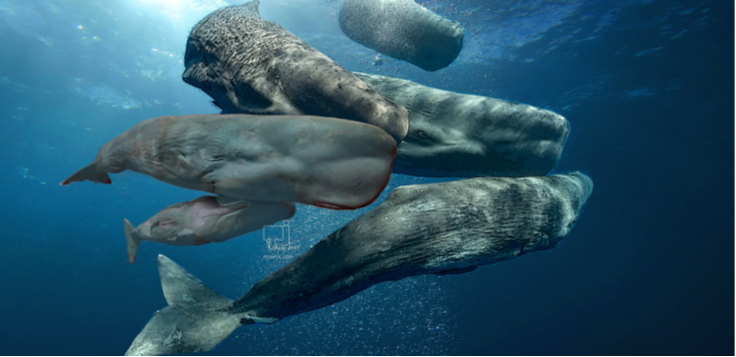
Researchers studying thousands of recorded calls have discovered a kind of “sperm whale phonetic alphabet” embedded in their strings of “click” sounds. The finding suggests these whales have a communication system considerably more complex than previously thought. It also adds to almost a century of research on animals and insects that has chipped away at the long-held notion that humans alone possess an intricate system for conversing with one another. For sperm whales, bursts of clicks known as codas come in different varieties and form the building blocks of speech, just as human language emerges from the different vocal sounds we combine to form words and sentences. The whales shape these codas into some 300 types by varying their duration, rhythm and tempo, and sometimes by adding an extra click. The researchers describe their discovery in a study published Tuesday in the journal Nature Communications. “The very important caveat to add here is that we still don’t know whether you want to think of a coda as being a word, or like a sentence, or like an individual vowel or consonant,” said Jacob Andreas, an associate professor in electrical engineering and computer science at MIT who is one of the authors of the new study. “The big payoff here, the way you figure out what they’re actually talking about, how this communication system works and what things mean,” he added, is by trying to link the specific calls to a whale’s behavior. “And that is something we’re actively working on now.” Robert Seyfarth, an emeritus professor of psychology at the University of Pennsylvania who was not involved in the research, called the study novel and important. “It is also a technological achievement, because studying whale communication poses problems not encountered when studying terrestrial species that are easy to observe,” he said. https://www.washingtonpost.com/science/2024/05/07/sperm-whale-alphabet-clicks/
What? Communicating with each other? They aren’t just practicing for their appearance on “The World Has Talent”? First, we have a Sumatran Orangutan who knows how to go to the ‘medicine cabinet’ to patch up the hole in his face; a talent for which scientists are ready to take this as a sign of intelligence. We knew Humpbacks sang songs that sold lots of albums. Could their songs also be a language? Now we have Sperm Whales who communicate with each other…
What is the world coming to? Perhaps we will one day have politicians who attempt to build a better world than simply making sounds for ‘sound bites’. Standing behind a criminal, knowing that he is a criminal, in order to get opportunities to work in the White House and the leap to becoming someone “important”. Perhaps we may eventually have world leaders who decide to save this planet, so that my very young grandsons will have a world to look forward to when they become teenagers.
var sc_project=4646431;
var sc_invisible=0;
var sc_security="637e2ba8";
var scJsHost = (("https:" == document.location.protocol) ?
"https://secure." : "http://www.");
document.write("");